StratNavApp.com banner ad

🪦 Welcome to the AI Graveyard.

Here lies:
  • The never-launched pilot that impressed the board but never made it into production.
  • The vibe-coded AI app that got a standing ovation at hack day… then disappeared.
  • The enterprise subscription quietly draining budget while no one logs in.
Sound familiar?

We’re living through an epidemic of shiny new thing syndrome — especially with AI.

A new tool drops, a demo video blows up, your competitor announces a pilot, and suddenly the race is on. You rush to keep up. You assign a team. Maybe even buy a license. 🚀

And then… nothing.

The initiative fades. The next “next big thing” steals the spotlight. And the last one? It’s left to rot in digital limbo.

The cost?

Not just the money — though that adds up. It’s the opportunity cost of never seeing things through. Of spreading effort too thin to make real progress.

💡 Strategy is the antidote.

If you:
✅ Take the time to decide what really matters
✅ Commit to learn, adapt, and iterate (even when the hype fades)
✅ Align new initiatives with long-term goals
…you’ll build systems and solutions that actually deliver value — not just headlines.

So, next time the shiny new thing comes knocking, ask yourself:

🔍 Does this support our strategy?
🧭 Are we solving a real problem or chasing novelty?
⚙️ Do we have the capacity to make this stick?

If not — pause. Plan. Prioritise.

Because success doesn’t come from chasing every trend. It comes from sticking with what matters.

💬 What’s the last AI (or other tech) initiative you saw quietly fade away?

Drop it in the comments — let’s share and learn.

Ready to develop a business strategy that will ensure your AI initiatives don't end up in the AI graveyard?

Try StratNav - the online collaborative and AI powered platform for business strategy development and execution. With free and paid plans available, there's not reason not to start now.

An image of a graveyard with AI projects on the tombstones


From code to C-Suite: How I got into strategy

I realise I have answered this question in so many conversations, but never written it down.

I started my career in software development in the 90s. It was a heady time, with the advent of client server computing, object-orientation, and, of course, the internet.

By the time of the dot.com boom, I as already rising through middle management into more senior roles, eventually running the software development capability for a very well funded startup online bank based in Cape Town, South Africa.

At the same time I was doing my MBA.

Well before the dot.com crash, I realised that, while the question I was being asked was "can you build it?", the more important question was "should you build it?"

It turns out I was exactly right. A lot of dot.com business that could be built shouldn't have been.

What followed, of course, was the crash.

But I had already made the transition for technology into strategy. I started by pointing out that the startup bank I was working for was trying to replicate a model from the UK into South Africa. I pointed out that the markets were very different, and therefore, so was what would and wouldn't work. I was tasked with remediating the problem. (Which I did.)

My journey into strategy initially led me away from technology and deep into financial services.

However, it quickly became apparent that lots of the problems and opportunities in financial services were very technologically oriented. So things tied together quite neatly.

It is also how I came to found StratNavApp.com. It was born out of a personal realisation that digital transformation was impacting almost every aspect of life, but the practice of developing and executing business strategy remained stubbornly unchanged. Most organisations I encountered relied on little other than Microsoft PowerPoint, Word and Excel.

There had to be a better way!

And, of course, as AI slowly emerged (even when it was still machine learning rather than Generative AI) it became evident that the digitisation of strategy was fundamental to its continued evolution. And StratNavApp.com was ideally placed to capitalise on it.

So my story is essential one of technologist turned strategist turned technologist!

If you found that at all interesting, please feel free to follow my continuing journey on:


What is human intelligence exceptionalism?

Human intelligence exceptionalism is the (almost certainly mistaken) belief intelligence which resides in a carbon-based life form is inherently different from and superior to intelligence that resides in any other medium.

Human intelligence exceptionalism is the belief that human intelligence is fundamentally unique, inherently superior, and cannot be meaningfully replicated in non-biological forms. This perspective is deeply ingrained in philosophy, religion, and culture, often rooted in the idea that consciousness, self-awareness, and higher reasoning are exclusive to humans—or, at most, to carbon-based life forms like ourselves.

However, this view is increasingly challenged by advancements in artificial intelligence (AI) and our growing understanding of cognition in non-human species. There is little scientific evidence to suggest that intelligence must emerge from biological processes alone. Instead, intelligence may be an emergent property of complex information processing, independent of the medium in which it occurs. If this is true, then a sufficiently advanced AI, or even an intelligence emerging in an entirely different non-carbon substrate, could exhibit capabilities equal to or exceeding human cognition.

Rejecting human intelligence exceptionalism does not necessarily mean denying human uniqueness. Rather, it invites us to consider that intelligence may be a spectrum that transcends biology. Just as silicon-based computers have surpassed humans in raw computation speed, non-biological intelligences may one day surpass us in creativity, reasoning, and problem-solving—challenging long-held assumptions about what it means to be intelligent.

Historically, human intelligence exceptionalism has been deeply tied to philosophical, religious, and scientific thought. Ancient civilizations often placed humans at the centre of the cosmos. In Western thought, this idea was reinforced by religious doctrines, such as those in Christianity, which asserted that humans were created in the image of God and granted dominion over nature (Genesis 1:26). This perspective positioned human intelligence as divinely ordained and distinct from all other forms of cognition.

During the Scientific Revolution, thinkers like René Descartes (1596–1650) reinforced human intelligence exceptionalism by arguing that only humans possessed rational souls. Descartes viewed animals as "automatons"—mechanical beings that lacked true thought or consciousness. This mechanistic view of non-human entities contributed to the notion that intelligence was an exclusively human trait, tied to a spiritual essence rather than a material process.

The 19th and 20th centuries saw significant challenges to human intelligence exceptionalism. Charles Darwin’s On the Origin of Species (1859) demonstrated that humans evolved from other life forms, suggesting that intelligence is not a divine gift but a product of natural selection. Later, cognitive science and artificial intelligence research further questioned whether human intelligence was unique. Alan Turing, in his seminal 1950 paper Computing Machinery and Intelligence, proposed that intelligence should be measured by functional performance rather than by the nature of the entity in which it resides. The Turing Test challenged the assumption that only biological beings could "think."

More recently, advances in AI, neuroscience, and synthetic biology have reinforced the idea that intelligence is a substrate-independent phenomenon. Machines now outperform humans in many cognitive tasks, from playing chess and Go to diagnosing diseases. This raises profound philosophical and ethical questions about the future of intelligence—suggesting that human intelligence exceptionalism may be less of a scientific reality and more of a psychological bias rooted in historical tradition.

The Role of Data in Strategy: Learning from the Past to Shape the Future

I am often told that data looks to the past while strategy looks to the future. And while this is true, some take it a step further and suggest this as a reason for not overly relying on data when developing strategy.

But if we don't rely on data, what should we rely on? 🤔 Not relying on data because it reflects the past doesn’t make much sense. After all, the past is all we have to inform us about what works, what doesn’t, and why.

The Past is Our Only Reference Point

When strategising, the future is inherently uncertain. No one can predict it with any certainty. But by looking back at past trends, patterns, and experiences, we can make educated guesses about where things are heading. Data helps us do exactly that—whether it’s quantitative metrics or qualitative insights. It serves as a reflection of what's happened before and, more importantly, why.

For instance, when market researchers examine customer behaviour, they aren’t just looking at yesterday's purchases. They’re analysing patterns — patterns that reveal how customer preferences have evolved and how they might continue to change. This kind of analysis allows companies to stay ahead of trends and innovate in ways that resonate with their target audience.

Steve Jobs and the Calligraphy Example

A common counter-argument to the use of data in strategy is the case of Steve Jobs, who famously designed the fonts for Apple based on his study of calligraphy during his college years. At first glance, it might seem that this story is about inspiration, creativity, and thinking outside the box, which aren't typically associated with data.

But let’s look at this a little more closely. What is the study of calligraphy, if not a form of qualitative data? Jobs was drawing from historical knowledge and techniques. He wasn't reinventing the wheel — he was building on the artistry, precision, and discipline of centuries-old traditions. By studying calligraphy, he was collecting data about the past in order to innovate in the present and future.

His decision wasn’t purely whimsical or gut-driven. It was an informed choice based on patterns of visual appeal, readability, and user experience that calligraphers had discovered and refined over time. In essence, it’s another example of how understanding the past can inspire future breakthroughs. 📜✍️

Data Provides Context and Insight

When we say strategy is about the future, what we really mean is that it’s about making decisions that will have future outcomes. The only way to make informed decisions is to understand the context, the landscape, and the forces shaping it.

Data — whether qualitative, like Steve Jobs' study of calligraphy, or quantitative, like sales reports and customer analytics—provides critical insights that help businesses assess risks, identify opportunities, and anticipate future trends.

Here’s why relying on data is crucial for strategic planning:

  1. Trends and Patterns: Data reveals long-term trends that would be impossible to spot otherwise. It shows how things are changing and helps us anticipate future changes.
  2. Risk Mitigation: By analysing past mistakes and successes, businesses can reduce the likelihood of repeating errors and increase their chances of success.
  3. Informed Innovation: Data doesn’t just tell us what happened—it can also reveal why it happened. Armed with this knowledge, businesses can innovate more intelligently.
  4. Competitive Advantage: Competitors who ignore data run the risk of making poorly informed decisions, leaving the field wide open for those who leverage data-driven insights to make smarter moves.

Balancing Intuition and Data

Of course, strategy isn't purely data-driven. There’s still room for creativity, intuition, and vision. Some of the best ideas come from out-of-the-box thinking, and not every decision can be backed up by numbers. But these creative decisions should still be informed by data. They should be rooted in an understanding of what’s been tried before, what succeeded, and what failed. Just like Jobs' development of Apple's fonts was.

The real magic happens when you balance intuition with data. Visionary leaders can see beyond the data, but they use it as their foundation. Without that solid base, even the most inspired ideas run the risk of being disconnected from reality.

So, Should We Rely on Data in Strategy?

Absolutely! While data reflects the past, it is our most valuable tool for shaping the future. Whether it's a market analysis, customer feedback, or even the study of ancient calligraphy, data provides a foundation for making informed decisions. Without it, we're left guessing or gazing into a crystal ball — and neither of those approaches is a sound business strategy.

The next time someone suggests we shouldn’t rely on data because it looks backwards, remind them that the past is the only lens through which we can view the future. What we choose to learn from it will determine how successful we are in charting the course ahead. 🌍🔮

See also:

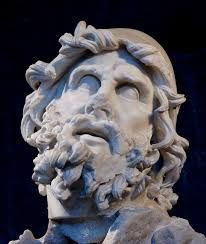
Odysseus: The original strategist

I like to think of Odysseus as the original archetypal strategist.

(In our western tradition, at least.)

Odysseus was known was the wiliest of the Greek kings that laid siege to Troy. A bit of a trickster, really.

The siege lasted for 10 years. It was a war of attrition. Sometimes the Greeks won a bit. Other times the Trojans won a little bit. Mostly, people died and little progress was made.

It was Odysseus who came up with the idea of the Trojan Horse (see below).

(Actually, the myths tell us it was the goddess Athena who whispered it in his ear.)

The Trojan horse allowed a handful of Greeks to defeat the Trojans where the whole army had failed for a decade.

And that is the heart of strategy. Winning by being cleverer and by doing something different. Not trying the same thing harder (longer, faster, better, etc.) despite disappointing results.

These are lessons from history which we would do well to apply when developing modern business strategies:

  • Don't try and match your competitors' strategies.
  • Look for a different, novel and surprising approach.
  • Focus on small things that can make a disproportionately big difference.
  • Don't show your hand too early.
  • If what you're doing hasn't been working, its time to try something else.

What do you think?

By the way: Stephen Fry's retelling of Troy (see right) is a fantastic read. If you want to know more about Odysseus and his tricks, I highly recommend it.

A quick summary of the Trojan Horse

If you're not familiar with the story of the Trojan Horse, here is a quick summary of what is one of the most intriguing and well-known tales from Greek mythology, particularly from the epic conclusion of the Trojan War.

After a gruelling and unsuccessful siege of Troy that lasted ten years, the Greeks devised a cunning plan to break into the city's impregnable walls. The brainchild of Odysseus, the scheme involved constructing a gigantic wooden horse, ostensibly as a peace offering to the Trojans but secretly harbouring elite Greek soldiers inside.

The Greeks built the horse and left it at the gates of Troy, while the main Greek army pretended to retreat, hiding out of sight. The Trojans, believing they had finally seen the Greeks off and won the war, debated what to do with the horse. Despite warnings from Laocoön and Cassandra to distrust the Greek gift, the Trojans, overwhelmed by curiosity and the thought of a Greek surrender, pulled the horse into their city as a trophy of their apparent victory.

The celebration was short-lived. Under the cover of night, the Greek soldiers hidden inside the horse emerged and opened the city gates to the rest of the Greek army, which had returned under the cover of darkness. The Greeks launched a surprise attack, leading to the fall of Troy. This pivotal event effectively ended the war, with the Greeks using deception and tactical ingenuity to overcome their enemies. The term "Trojan Horse" has since become synonymous with trickery and the subversive infiltration of an enemy, making it a lasting symbol of strategic deception.

Integrate generative AI into your business strategy

Has Generative AI lived up to its transformative promise?

2023 was undoubtedly the year we all played with Generative AI. 2024 should be the year it could transform your business.

Now, a little over a mere 13 months since ChatGPT launched, we can reflect on how it's changed things.

There is already a sense of the hype-cycle shifting with increasing frustration over what it can't do.

In my experience, a lot of this is based on a combination of misuse and unrealistic expectations.

Where to from here?

I remain optimistic about the possibilities of Generative (and other forms of) AI.

Like any tool, I am sure it can - and almost certainly will - be used badly and for bad purposes. But that doesn't detract from the opportunities to use it well and for good purposes.

So, how can we ensure that we remain on the right side of that equation?

Here are my tips:

  1. Always start with a business need. As with most new technologies there will almost certainly be more things that you *could* do than that you *should* do with it. Trying to everything at once, or prioritising at random will leave you chasing your tail. A clear business strategy will help you to prioritise where to put your efforts.

  2. Think different, not just better. AI will enable us to do many things that we already do, but better - faster, more consistently, more cheaply and at higher volume or with fewer people. While that's invariably a good thing, let's not lose sight of the opportunities to do things differently or to do different things. We need to be thinking about new products, services, processes, business models and strategies as much as we are thinking about improving the efficiency of existing ones.

  3. Think beyond chatbots: We've got think beyond typing questions into the ChatGPT/Bard etc. prompt box and then copy/pasting the answers into whatever else we're doing. We need to seamlessly integrate AI into our existing tools and processes, making it as ubiquitous and unintrusive in our daily operations as electricity or Wi-Fi.

    (We're already building it into StratNavApp.com where it helps users develop and execute better business strategies without them being aware of the details of the prompts and responses being written and consumed in the background!)
Reach out if you need help integrating AI into your business strategy.

The Critical Gap in Business Strategy Execution: Insights from Jan 2025

Reflecting on 2023, I made a startling discovery about business strategy! I have now updated this to reflect data from 2024.

I analysed* thousands of projects on StratNavApp.com during 2024. I found that of those that got as far as setting strategic goals and/or strategic initiatives:

  • A few more than 25% got as far as setting KPIs.**
  • Fewer than 18% actually tracked those KPIs.

That means that more than 82% of those strategies never progress beyond being a theoretical assumption about what should work. Even if they're executed, there is no way of knowing if they're producing the intended outcomes or not. They're flying blind!🚫👀

I challenge these organisations to:

  1. Break your strategic goals down into SMART objectives.🎯

    SMART stands for Specific, Measurable, Achievable, Relevant and Time-bound.

  2. Establish clear Key Performance Indicators (KPIs) for tracking each of them.🔍

    Together, these objectives and KPIs are often called Objectives and Key Results (OKRs).

  3. Regularly track actual performance against them.

  4. Analyse your performance against expectations.📊

    It's important to set expectations in advance, otherwise you risk simply settling for whatever results you get.

  5. Make appropriate adjustments to your strategy if the results aren't what you'd anticipated.🔄

    There is no point in just carrying on with your strategy if it is not producing the intended results.

  6. Keep repeating as you watch your business flourish.🌱

Fortunately, StratNavApp.com provides you with all the tools you need to do this in one convenient place. It even uses AI to help break through any barriers you might encounter. You can learn more about how it does this at Goals, Objectives, KPIs, Targets, Initiatives and Actions and Creating a Strategy Scorecard.

If you need more help than that, please contact me.

But don't hesitate. The sooner you start the sooner you can start enjoying a more successful 2024!

Share your thoughts and questions in the comments below.👇

Notes:

* NB: StratNavApp.com provides the ability to do this kind of analysis without ever looking at what your strategy actually is. Your strategy is always confidential to only you and those you choose to share it with.

** The actual figures are 25.59% (up from 23.9% in 2023) set KPIs and 17.42% (down from 19.1% in 2023) tracked them. The decrease in strategies tracking KPIs may reflect an increase in the total number of strategies analysed, rather than an absolute decrease.

*** Some strategies built in StratNavApp.com may have built and tracked their KPIs on another platform. We estimate this number to be small as a virtue of StratNavApp.com is that it provides an integrated platform for strategy development and execution.

See also:

Strategy: More Than Just an Annual Ritual - It's a Continuous Discipline

It's very important that your business complies with the law.

You need to enter into contracts with employees, suppliers, distributors, and customers. You need to make sure that those contracts are fit for purposes, and that both you and your counterparties comply with their terms.

One way to ensure your business remains legally compliant is to take your top leadership team on an Annual Legal Retreat. Over the course of 1-3 days, you can discuss all of the legal issues that might apply to your business, update yourselves on recent legal developments, and make all the decisions you need to make until next year's Legal Retreat.

And since your organisation's leaders are your top employees in disciplines like operations, marketing, human resources, and finance, they should have no problem covering the full gamut of the law in just a few days once a year.

I am, of course, joking! That would be absurd!

We don't expect to handle everything to do with the law - or with financial management, human resources, marketing, operations - in a short off-site once a year.

So why do so many organisations think that they can get away with doing that with strategy?

Is having - and successfully executing - a sound strategy less important than any of those other things?

You don't go on an annual marketing retreat, you hire a CMO or a marketing consultant. You don't go on an annual HR retreat, your hire a head of HR or an HR consultant. You don't go on an annual legal retreat, you hire a lawyer or engage a law firm. You don't... you get the picture.

Like all those other disciplines:

  1. strategy is a unique discipline requiring specialised skills and experience.
  2. effective strategy demands year-round attention, not just an annual review.
  3. modern strategy needs tools - which in today's world means software like StratNavApp.com - which are fit for purpose.
Your strategy is executed in everything you do - in every decision you make - every day. And it is impacted by and may need to be adjusted in the face of external market events which can arise at any time. This can't be handled on a 2-day offsite once a year.

Your options are:

  1. Hire someone: You can hire a Chief Strategy Officer (CSO) with the right skills and experience in doing business strategy and give them a seat at the top table, just as you're hire a Chief Financial Officer (CFO), Chief Marketing Officer (CMO), HR Officer (HRO), etc.
    or

  2. Use external consultants: If you're a smaller organisation and can't afford permanent dedicated resource, or even if you just need some extra lifting power from time to time, you can hire experienced and expert strategy consultants (like Chris C Fox Consulting!) to help,
    and

  3. Use purpose-built software: Both of the above approaches are significantly enhanced by using dedicated software, like StratNavApp.com, for strategy development and execution, just like you probably use dedicated accounting software, marketing tools and an HR Management System (HRMS). This will ensure that your strategy is both soundly formulated and executed with discipline.

Share your thoughts in the comments below: Does your organisation take strategy seriously enough? Or does it pay lip-service to strategy once a year and then hope for the best? Let's discuss how we can shift the narrative from strategy as an annual event to a continuous discipline.

If you need help with you business strategy or any related issues, contact me for a no-obligation consultation.

P.S. Remember, strategy is not just an annual checkbox. It's the guiding force that drives your business forward every single day. 🚀

Navigating the Shift: Balancing Self-Service Tech and Human Interaction in the Age of AI

Since the birth of the internet we've been grappling with the balance between online self-service and service delivered by real human people.

The historic context

To date, interacting with computers has been fairly restricted. Computers relied on structured input and relatively simply choices. Online self-service has largely relied on menus (for choices) and forms (for structured inputs). These were not always intuitive to use - especially for customers. User Experience (UX) and User Interface (UI) Design developed as complex specialities within digital transformation to try to over come these difficulties.

But for many users, this was still simply too difficult. And so they continued to rely on speaking to real human people.

Call centres grew in response to this demand. Operators either did things for customers in the first place, acting as an organic interface between the customers and the systems they were unable to interact with on their own, or a trouble-shooters helping customers to figure out how to interact with the computers or correct the errors they'd made.

The net effect was that we paid call centre operators to act as intermediaries between customers and computer systems because the computer systems were too difficult for the customers to use themselves.

(I am not ignoring the fact that some customer simply prefer to talk to real people. But I question how much of that preference is driven by the fact that it is too difficult to do things any other way?)

Using call centre operators as intermediaries brought its own challenges. It's obviously more expensive to pay operators to act as intermediaries than not to (all other things being equal). The work itself is often very repetitive and not very engaging, leading to high turnover rates and high recruitment and training costs.

And, for customers, it leads to long call-waiting queues, being passed from one operator to another, and dealing with sometimes under-trained operators.

Attempts to relieve some of the pressure, like Interactive Voice Response (IVR) and chatbots were relatively primitive and often only served to increase customers' frustrations.

Much of this cost and frustration can be attributed to Failure Demand*. That is costs incurred because the customer didn't get what they wanted without it. (*As opposed to Value Demand, which is the demand for what customers actually want.)

So what is changing?

In 2023, the capability balance between online self-service and service delivered by real human people shifted dramatically.

This change is being powered by the development of Large Language Models (LLM) and Transformers (like Generative Pre-trained Transformers or GPTs) coupled with improvements in Natural Language Processing (NLP) as exemplified by OpenAI's ChatGPT, Google's Bard and many others.

Intelligent agents are now able to deliver a much more personal and human-like interaction than ever before.

Chatbots and IVRs are progressing from being frustrating barriers to getting through to a real person to being really useful agents that can solve problems quickly, consistently and efficiently.

They can receive information in natural language, respond in natural language, and carry the context through the multiple interactions which make up a typical conversation.

These conversations can be text-based (typed and read) or, using text-to-voice and voice-to-text converters, they can be auditory (spoken and heard). It will become harder and harder to determine whether the voice on the other end of the line is human or automated (or whether it is a person or a computer responding to your chat or email messages).

Such systems will start to replace many traditional menu and form-based computer interfaces with natural language interfaces. AI in customer service will enable more customers to self-serve more, more easily, more effectively and more pleasantly. But it could also have similar impacts on internal systems and interactions with suppliers, distributors and other business partners.

And as such processes become more automated, it will become easier to ensure they are compliant with both internal policies and external regulations.

This will inevitably start with the very simplest of interactions only, but will gradually spread to more and more complex interactions as the technology improves and proves itself.

Conclusions

Just as the internet, and then mobile devices, changed customers' expectations of convenience, so too will this new age of intelligent agents transform the future of customer interaction.

Businesses that don't respond will soon find they are getting left behind.

It is important to start engaging and experimenting now, even if it is only with relative simple and non-core processes.

In order to reduce and better manage the inevitable risks of change, organisations could, for example:

  1. start experimenting with internal processes such as human resources and IT support, and then distributor and supplier facing processes, before extending this to customer-facing processes.
  2. start experimenting with a "human in the loop", like letting AI prepare email responses (or parts thereof) but still having a human read and amend them (if necessary) before sending them.

How is your business rising to this challenge?

If you need support, reach out to me for a conversation on navigating this evolving landscape.📞

See also:


Getting the most out of Generative AI

Are you getting the most out of Generative AI?

Unlocking the full potential of Generative AI (like ChatGPT) can revolutionize your workflow, your business and your strategy.💡

But did you know there are 6 key levels and 4 sub-levels to master?🚀

Picking the right one(s) can dramatically improve your results.✨

Level 1: Using the original ChatGPT Interface

You can, of course, still using the original ChatGPT chat interface as it was launched on 30 November 2022 to ask it simple questions.

Most people have tried this. And it turns out that ChatGPT is great when used in this way to, for example "write a poem about business strategy in the style of Dr Seuss" or "explain the causes of the first world war."

That in itself was revolutionary. For the first time we have a computer system where we could ask questions in  natural English, get answers in natural English and then ask follow up questions and have those answered within the context of the conversation thus far.

But it quickly emerged that, to get it to do anything more useful required more careful thought.

The original ChatGPT prompt interface allowed from prompts of up 4,000 characters. Simplistic prompts of c.100 characters were significantly underutilising this new technology.

And so the idea of "Prompt Engineering" arose.

Prompt Engineering is the science of providing Generative AI systems with more detailed and thoughtfully framed prompts to perform more complex and useful functions.

Boffins at places like MIT jumped on the bandwagon and produced longer and more complex prompts. They made them available for free or for a small fee. People started collecting prompts in documents from where they could cut and paste them into the ChatGPT interface and customise them as required.

It worked, but all the copying and pasting got a little tedious.

Level 2: Uploading Files

One of the first improvements was the ability to upload and query files.

The could be PDF or Excel files. (It turns out that ChatGPT is particularly good at analysing the data in Excel files.

Initially, this required plugins. But these capabilities were eventually built into the core product.

Level 2: Adding Custom Instructions

The addition of custom instructions reduced some of the tedious copying and pasting.

Custom instructions allowed you to provide some context which it would apply to all future conversations. 

For example, I could tell it "You are a business strategy consultant", "You use British English", "You communicate in a professional but friendly tone tone and don't use unnecessary adjectives."

This can improve your responses quite dramatically.

But you can only have one set of custom instructions, and that means you can only have one "persona" with ChatGPT. 

That's where GPTs come in (see level 4).

But first...

Level 4: Accessing the Internet

One of the biggest shortcoming of ChatGPT when it first came out was the fact that it was training on historic data only. This was less of a problem on the paid version of ChatGPT, but even that was always a few months behind the times.

That all changed with the integration of Bing. You can now ask ChatGPT to access a specific web page, or to search the Internet for specific information from which to provide responses. So, more or less, it it is on the Internet, and especially if Bing can find it, you can operate ChatGPT on it.

Level 5: Custom GPTs

Level 5a: Multiple Custom Instructions

Custom GPTs were a huge step forward. At their most basic, they allow you to create multiple sets of Custom Instructions. So you can create multiple personas trained on different instructions and switch between them with ease.

I've already built about 10 of these.

For example, I trained one on my tone of voice and preferred marketing channels to help me to develop and enhance marketing messages. I trained another on my professional track record and business offering to help me together consulting proposals. I trained a third to know what technology stack StratNavApp.com is built on so that it can help me with coding and technical trouble-shooting. And I trained a fourth on how search the Internet to support commercial due diligence on organisations I am looking at.

Level 5b: Uploading Knowledge

In addition to Custom Instructions, GPTs allow you to upload documents containing knowledge. The GPT can then use that knowledge in performing tasks for you.

For example, I uploaded a document summarising my consulting experience as well as client endorsements to my GPT for writing consulting proposals. The GPT can then extract the most relevant examples from that to use in its responses.

It would be easy to upload staff manuals, customer instruction manuals, contracts and agreements and all manner of other content and then to build GPTs around them to allow people to work with the information more intuitively.

Level 5c: Integrating APIs

The ability to upload static knowledge documents is powerful enough. But ChatGPT also allows you to integrate with systems via standard APIs. So you could build a GPT which now only knows the specs of all of the products in your product catalogue but can also tell you whether they're in stock at your local store.

Of course, APIs don't just provide information, they can also take in, store and act on it. So you could train a GPT on your product support manual, but also enable it to log a support ticket in your ticket tracking systems if it can't answer your support query. Or you could have it place an order for a product once it has confirmed stock levels and prices.

This means that GPTs can operate as 'intelligent agents', taking care of tasks for us.

Level 5d: The GPT Market Place

If writing prompts was complex, writing GPTs can be even more so. Just like we have experts engineering prompts that users can cut and paste into the chat interface (see level 1), expert GPT builders can also build and share GPTs with other users.

At the time of writing this, OpenAI have not yet released their official GPT marketplace, although they've promised it before the end of January 2024. I imagine this will operate much like the iOS and Android app stores, with GPTs available for free or at a charge.

In the mean time, it is still possible to share GPTs, as long as you know where to find them (or someone shares a link with you).

Level 6: Using ChatGPT's APIs

ChatGPT's API provide the final level of flexibility and control. You can embed Generative API into your existing applications or Low-Code/No-Code solutions.

If expect that this is where the most powerful applications of Generative AI will emerge. At the same time, the technology will disappear from view, working tireless and yet unseen in the background like electricity and Wi-Fi already do.

StratNavApp.com already uses the ChatGPT API to perform a number of tasks related to developing and executing business strategy. Of course, the users don't see the prompts or the responses passed between StratNavApp.com and ChatGPT. They only experience the results without having to worry about the behind the scenes complexities. (Although we do tell them when we're using ChatGPT for transparency's sake!)

More and more applications are embedding Generative AI in similar ways. In fact you may already be using several without knowing it!

Chat GPT versions

Chat GPT is available in a number of versions: the free version, the paid retail version, the enterprise version and the APIs. Various of the features mentioned above are only available on some of these versions. In addition, each version comes with different levels of privacy and security, as well as underlying LLM models with different strengths, weaknesses and currency levels.

A full discussion of these versions and their implications is beyond the scope of this post, but important to understand as you plan your adoption strategy.

In conclusion

If you're an individual, you should be working your way up to level 4b. If you're an organization, you should be working your way up to level 6. You should be providing your staff and customers with solutions which harness Generative AI enhance their experience.

If you're still stuck on level 1, you're missing out on most of what the Generative AI revolution has to offer.❌

I spend most of my time at level 5, getting fantastic results. And, of course, StratNavApp.com is investing heavily at level 6 and getting even better results!

What level(s) are you working at? How is it going for you?

Are you using Generative AI like ChatGPT effectively in your business?

Contact me for help.

See also:

6 Levels as a pyramid

The Myth of One-Size-Fits-All Strategy: Beyond Simplistic Advice

The Limitations of Simplistic Strategy Quotes

I've always been fond of insightful #strategyQuotes that distil some element of wisdom into a single line.

You can see some of my favourite quotes about business strategy here. I also frequently post to #strategyQuotes on LinkedIn.

But real strategy and leadership are far more intricate than any single quote can convey.

Soundbites - no matter how appealing - are not enough!

Soundbites Are Not Enough for Real Strategy

It's easy to get drawn to the allure of simple solutions.

Phrases like "the one thing you need to know," "the only advice you need," or "the ultimate answer to success" are not just oversimplifications; they can be downright misleading.

The real world of business strategy is seldom that straightforward.

Beware the Snake Oil Salesmen

When encountering recommendations that sound too good to be true, remember that they often are. 

Even straightforward directives such as "do this" or "don't do that" should be approached with caution unless they're grounded in a thorough analysis of your unique and current situation.

The Wisdom of Thomas Aquinas

An early mentor of mine often cited Thomas Aquinas, who warned, "Beware the man of one book." 

This is a valuable reminder in the context of strategy and leadership. There is no single method, tool, technique, or piece of advice that works universally. Each situation demands a bespoke approach.

The Diverse Toolbox of the Leader

Effective leaders and strategists understand the importance of a diverse set of insights and methods. The skill lies not just in having these tools but in knowing when and how to apply them.

See also: Essential Tools for Strategy Analysis

Image from Jack and the Beanstalk
Beyond Magic Beans: The Need for Tailored Approaches

The notion of easy routes to success belongs in fairy tales like Jack and the Beanstalk, and has no place in business. In the real world, we need more than magic beans; success requires strategies that are tailored to our specific circumstances and executed with discipline.

If you need help finding the right strategy for your business, contact me for a free no-obligation consultation.

Poets versus Quants: the battle lines of business strategy

When I did my MBA, it was fashionable to describe students as either Poets or Quants. 

What does this mean? And what are the implications for developing and executing business strategy?

Understanding the Dichotomy

The distinction between poets and quants revolves around their approach to problem-solving.

Quants are the data-driven analysts who thrive on precision. They develop models for virtually every scenario, dissecting problems into quantifiable pieces. Quants view the world through a numerical lens, seeking patterns and trends in raw data. They tend to prefer structured, data-driven approaches and objective reasoning.

They're more likely to have backgrounds in STEM subjects (Science, Technology, Engineering and Mathematics).

Poets, on the other hand, are more disposed towards qualitative analysis. They possess an uncanny ability to read between the lines, discerning the broader implications of events or news. For poets, intuition and narrative are paramount. They tap into the pulse of the market, often discerning opportunities where others see none. They're more likely to be comfortable with ambiguity, narrative and subjectivity.

They're more likely to have backgrounds the humanities and the arts.

In summary:

Poets Quants
Intuitive and qualitative approach Data-driven and quantitative approach
Ability to read between the lines Precision in analysis through models
Discern broader implications of events or news View the world through a numerical lens
Rely on narrative and subjectivity Prefer structured and objective reasoning
Comfortable with ambiguity Thrive on identifying patterns and trends in raw data
Often discern opportunities where others see none Break down problems into quantifiable pieces
Backgrounds in humanities and arts, offering diverse views Backgrounds in STEM, emphasizing logical analysis
Tap into the pulse of the market Use mathematical models for scenarios and predictions
Value intuition, gut feelings, and experience Rely on empirical evidence and data validation
Embrace narrative to communicate and persuade Use data visualization and statistics for communication
Able to grasp cultural, social, and emotional nuances Strong in algorithmic thinking and systematic processes

The "Billions" exemplar

The tension between poets and quants is epitomised in the hit TV show "Billions".

Protagonist and poet Bobby "Axe" Axelrod, founder of Axe Capital, is an intuitive trader with an uncanny ability to read situations, understand the broader implications of news or events, and act on gut feelings.

But he is wise enough to employ plenty of quants on his team.

Most of the time, this works well, with the poets and quants bring different perspectives which either corroborate or disprove each others' hypotheses.

But it also leads to conflict, resulting, in the end, in quant Taylor Mason leaving Axe Capital to set up a rival firm. And so, the battle lines between the poets and the quants are drawn in even sharper relief.

This is, of course, just a TV show, and dramatised for entertainment.

But people familiar with trading floors around the world assure me that this dynamic plays out in real life on an ongoing basis. The quants built ever more sophisticated models to eke out ever small margins at ever larger volumes. The poets spot real-world events and intuitively understand their implications.

The Interplay of Skill Sets

While it's tempting to pit poets against quants, the reality is more nuanced. Good strategy requires both. 

The best strategists can seamlessly blend quantitative analysis with intuitive insights. For those who don't possess this both skills, it's crucial to have a mix of both types on their team.

However, this blend is not without its challenges. Poets and quants can often find it challenging to communicate with each other, given their distinct approaches. It's almost like they're speaking two different languages.

But it's precisely this diversity of thought that can lead to ground-breaking strategies.

Developing more rounded perspectives

Interestingly, it seems easier to introduce a liberal arts major to the world of basic mathematics than to immerse a math major in the world of liberal arts.

In his book "Innumeracy", John Allen Paulos defines innumeracy as the mathematical equivalent of illiteracy. He goes on to argue that innumeracy is much more widespread that illiteracy. He points out that it's socially acceptable to admit to being bad at math, but it remains taboo to admit to being illiterate, despite the fact that both have similar real-world consequences.

Paulos attributes this problem to the way maths is taught at schools. The suggestion is that can easily be corrected through improved maths education.

Teaching quants to be more like poets is a harder problem because it requires them to change the way they see and interact with the world.  Because a well-entrenched quant perspective is very structured, it offers fewer gaps into which alternative viewpoints can be introduced from outside of the frame of reference.

As the world becomes increasingly driven by data, innumeracy will become an increasing problem.

Bridging the gap

Aswath Damodaran is a renowned professor of finance at the Stern School of Business at New York University. He is best known for his work on valuation, corporate finance, and investment strategies. One of Damodaran's unique contributions to the field of finance is his emphasis on the interplay between numbers (quantitative data) and narratives (stories).

He argues that purely quantitative models often miss the bigger picture of the context in which a business operates. Conversely, a story without number can be too vague, or baseless. The best understanding comes from a compelling narrative that is backed and illustrated by data.

To work, the narrative and the numbers must be consistent. For example, if the narrative is one of growth, then the numbers should reflect this. Equally, if the numbers reflect growth, there must be a narrative which backs this up.

The narrative should, for example, explain where the growth would come from. Is it driven by changing customer behaviours, a technological breakthrough, or by expansion into a new market?

Narratives are a great way of dealing with uncertainty. For example, the narrative could explain growth if some future event comes to pass, but decline if it does not. This might even lead to two different sets of forecasts with narrative explanations of the difference between the two. This has far more explanatory power than a purely quantitative model, even one using sophisticated methods like monte carlo analysis.

And finally, narratives are easier to adjust when new information comes to light. Of course, when the narrative does change, it is imperative that you adjust the numbers that support it.

The objective, whether you use narrative or quantitative methods, is the same - to make a decision. And any decision about the future will also entail an element of risk. But, combining that narrative (poet) and quant perspectives in this way, can significant increase clarity and confidence in decision-making.

Conclusion

The world of business strategy is vast and multifaceted. While poets and quants may represent two ends of a spectrum, the future belongs to those who can navigate both realms with agility. In the dance of numbers and narratives, the key is to strike the right balance and integrate the two perspectives.

Next Steps

  1. Consider where you personally fall on the continuum between poet and quant.
  2. Consider where each of your team members fall on the continuum between poet and quant.
  3. Consider whether you processes for developing and executing strategy are weighted towards quantitative or qualitative perspectives.
  4. Take steps to include additional people or change your processes to increase the degree of balance between and better integrate the poet and quant perspectives.

See also:

Strategic Inception

Most of the best strategies I've encountered hinge on a single strategic insight.

Or, perhaps, a very small number of them.

Peter Compo, author of "The Emergent Approach to Strategy" calls this The Bottleneck. Richard Rumelt, author of "Good Strategy, Bad Strategy" calls it The Crux. Military historians talk about Napoleon's Glance.

Even better is when that single strategic insight is so compelling it one cannot fail to act on it. When it is so elegantly simple that, once seen, it cannot be unseen.

In one client I worked with, it was the realisation that customers who exhibited a certain behaviour were over 4 times more likely to purchase their product than those that did not. In another, it was understanding how their sales teams actually spent their time, given that they lacked the data and support which would enable them to act more effectively. (Apologies that confidentiality requires me to be a little vague about the details! In both cases, of course, the context is vital.)

Leonardo DiCaprio in the firm Inception
Leonardo DiCaprio in Inception
In the film "Inception", the character played by Leonardo DiCaprio says "Once and ideas has taken hold of the brain, it's almost impossible to eradicate."

In that film, the protagonists have access to fantastical technology for embedding ideas in people's brains in a process they call Inception.

Sadly (or perhaps gladly, when you see how the film turns out), we don't have access to that.

And so our work is:

  1. to keep delving until we uncover that single strategic insight that compels action, leaving no stone unturned until you have the Eureka! moment,
  2. to embed it throughout the organisation through regular repetition of an elegantly simple explanation of that insight,
  3. without becoming so beholden to it, that we fail to notice and adjust when the circumstances around us change.

We can, of course, settle for less. There are plenty of strategies which are "good enough". But if we want truly great strategies, then that is the task we must set ourselves.

The future is already here - it's just not very evenly distributed

"The future is already here" #strategyquotes card
"The future is already here - it's just not very evenly distributed." - William Gibson*

This is one of my favourite quotes about the future.

People say that it is hard to imagine what the future could be like.

But the clues are all around us.

There are the science fiction writers extrapolating current trends into imaginary futures. There are the early adopters using barely ready products in ways that might never have been anticipated. There are boffins in white coats discovering new technologies. The are other industries who've found innovative solutions which could be adapted to our own. There are the dreamers and innovators hidden in plain sight among us.

To see the future, we only have to look hard enough.

COVID provided a great example of this. It forced many to adopt remote working for the first time. But pioneers had been doing this for decades and could demonstrate best practice to those willing to look.

Similarly, scientists had been worrying about climate change long before it penetrated popular consciousness.

All it requires is for us to look: widely and with curiosity. To see things and say "I wonder..." rather than "that'll never work for us!"

In business strategy, we talk about detecting "weak signals" and "separating the signal from the noise". It requires systematic application. But it can - and should - be done.

And StratNavApp.com provides the perfect platform for doing so!

* William Gibson is an American-Canadian science fiction writer.

Why you should engage an independent business strategy consultant in your first 100 days

Image of a calendar

Your first 100 days in a CEO post are critical. The whole organisation is watching to see what you will do.

Will you make big changes? What style will you employ?

And you may have big ideas about both.

They're the reason you signed up for this gig. They may even be what you got you to the top of the pile of applicants in the first place.

But now that you've got your feet under the desk, it's turning out not to be as easy as you thought.

The organisation's problems seem a little more complex. The data you need is unavailable or not as clear as you'd hope it would be. Some members of your team don't seem as co-operative as you'd like.

You know you could sort it out. But you just don't have the time to get round to it all. Fires keep popping up and draining your attention: an unhappy customer, a problem in production, an underperforming staff member.

The high hopes you started the role with are starting to sink.

That's when you need help.

The challenge

Your challenge in the first 100 days is to:

1. Build strong relationships with your team

You represent change - you are a change. And that can be unsettling. The period of time leading to your arrival, and the reason a new CEO was required in the first place might also have been unsettling.

So it is important to invest time in building strong relationships of trust. And that requires listening and learning. Which brings us to:

2. Establish the specific facts on the ground

You have plenty of experience. You may even know the industry very well. But you probably don't know the specifics of this particular business.

You need to take time to understand the problems that the people who work there every day experience, as well as how outside stakeholders (customers, shareholders, distributors, suppliers, etc.) experience the organisation. You need to understand the history of why the organisation is the way it is. And you need to do so without appearing to cast blame. This requires talking to people and listening to what they say with patience and openness.

3. Come up with a diagnosis

Eventually, you will need to come up of the fence and give a view on what you believe the underlying challenges and opportunities facing the organisation are.

This may not be fundamentally different to what you thought when you started the process (although it probably won't be). But because you took the time to listen, people will feel more invested in your conclusions.

4. Introduce new ideas slowly and deliberately

You will almost certainly want to introduce new ideas. But do so slowly and deliberately. Give people time to digest the new ideas, to understand the benefits, and to consider the application of the ideas in their specific context.

Think of yourself like a teacher, revealing new concepts to their students incrementally, and allowing them time to explore and absorb them.

5. Propose a plan of action

The best plan of action is one that comes from your team. Your role is to coach, coax and challenge.

It's important to be realistic about the rate of change the organisation is able to sustain. It's unrealistic to expect an organisation to go from under-performance to high-performance overnight. So your plan may need to incorporate a sustained programme of improving the capacity for change itself.

The hardest parts of any plan are those that involve people. Perhaps a restructure is in order. Or perhaps you've concluded that some key members of your team are not right for their roles and require development, redeployment or even a managed exit. This is where the groundwork you've laid in previous steps will pay extra dividends.

6. Focus on the Why

We know that people respond better when they understand the Why of what is being asked of them. So it helps to distil your diagnosis and plan into a clear an compelling explanation why it matters.

This can take the form of a statement of purpose, a mission statement or a vision statement. It should tap into people's emotions as well as appeal to their logic.

7. Communicate

It will be hard to over-communicate during this period. Your new team are trying to learn how you operate, what they can expect from you, and what you expect from them.

And they will need constant reminders of your diagnosis, plan, and their role and contribution in establishing these.

All of this takes work, application and effort.

The solution (part of it)

And an independent business strategy consultant is just the right kind of person to give you the help you need.

They can provide:

1. Capacity and Experience

While you're fighting those fires and attending to the myriad other things that come with the role, a consultant can be digging into that data, conducting research, generating and evaluating options. And because they have plenty of experience of having done this before, they'll need limited guidance and can keep you appraised of only the most important and relevant conclusions, saving you time.

2. Objectivity

Your new team are still sussing you out and vying for position. Maybe they were even hoping for the top job themselves. Perhaps they'd sooner see you fail than change the status quo.

An independent consultant has no such vested interests. So they can give you an unbiased and objective assessment, as well as a fresh perspective on what's really happening.

This fresh perspective is particularly important if your existing team has been in the organisation for some time. They're as likely to be part of the problem you need to solve as they are to understand it or know how to solve it.

3. Ownership

With an independent consultant, you can agree the terms of the engagement up front.  These can include your strategic ambitions and concerns. The consultant is there to do the heavy lifting to confirm or disconfirm your hypotheses and to fill in the blanks.

They don't bring their own agenda. They don't bring the pre-packaged solutions that they just sold to your competitors. They don't overwhelm you with an army of junior consultants, muddying the water and burning your political capital with your new team.

And when they're done, they leave you, the owner of your strategy.

4. Cost effectiveness

A short, sharp engagement can be very cost-effective. You get all of the long-term benefits outlined above. But you only pay for the duration of the engagement.

Contact me, if you're looking for help in your first 100 days.

See also:

Helmuth von Moltke The Elder

Helmuth von Moltke the Elder, the renowned Prussian general and military strategist, left an indelible mark on the field of strategy. Born in 1800, Moltke's contributions to the art of warfare continue to influence military thinking to this day. His ideas and principles provide valuable insights not only in the context of the battlefield but also in various domains where strategy plays a vital role.

Moltke firmly believed in the dynamic nature of strategy. He emphasized the importance of adapting plans to changing circumstances and understanding the fluidity of the battlefield. His famous quote, "No plan survives contact with the enemy," encapsulates this sentiment. Moltke recognized that strategy should be flexible, enabling commanders to adjust their tactics as the situation evolves.

Another key aspect of Moltke's strategic thinking was the holistic approach strategy. He understood that military action should be integrated with political, economic, and social factors. Moltke recognized that a comprehensive understanding of the broader context is essential for developing effective strategies. This concept of viewing strategy as a multidimensional endeavour is equally applicable in business, politics, and any domain that requires long-term planning and decision-making.

Moltke's emphasis on the importance of clear objectives is another valuable lesson. He believed that setting specific goals and aligning all efforts towards their achievement was crucial for success. This principle holds true in any strategic endeavour, whether it is formulating a marketing campaign, managing a project, or even pursuing personal goals. Defining clear objectives allows for focused efforts and better resource allocation.

Moreover, Moltke's strategic philosophy emphasized the significance of understanding one's strengths and weaknesses. He recognized that an accurate assessment of capabilities, as well as those of the opponent, is essential for devising effective strategies. This self-awareness and realistic evaluation of the situation are crucial in making informed decisions and exploiting opportunities while mitigating risks.

Helmuth von Moltke's contributions to strategy extend far beyond the battlefield. His principles of flexibility, integration, clear objectives, and self-awareness provide valuable insights applicable to various domains. Whether it is in military campaigns, business ventures, or personal pursuits, Moltke's strategic thinking remains relevant and continues to inspire those seeking success through well-crafted strategies.

All of the above is a simple excuse to post this picture ;-)

I was lucky enough to visit Berlin last week and chanced across this statue of Moltke whilst walking through the Tiergarten. So I asked my daughter to take this picture. She thought it would make a pleasant change from "all that boring strategy stuff you talk about". Little did she know...

Image of me standing at the statue of Moltke in the Tiergarten

It's not just all about the customer

Feet standing on a smiley face

Many people talk about business strategy as if it is all just about satisfying customer needs.

It's not.

Satisfying customer needs is an important - vital, even - part of it. But just satisfying customer needs alone is not enough. It also matters who satisfies them and how they do it.

I propose that there are three levels of thinking in this area.

1. It's all about satisfying customer needs.

This is the most basic level of thinking - as described above. What I would describe as a "marketing-oriented" or "outside-in" view of strategy.

(This is not intended as a criticism of marketing or marketers! It's an important perspective. But only part of the puzzle.)

It works from the assumption that all we need to do is to work out what customers want and need, and then work out how to give it to them.

It's an important piece of the puzzle - but there is much more to thinking about an organisation strategically.

2. It's all about matching the organisation's capabilities to customer needs.

A more "inside-out" approach would first consider the organisations capabilities and resources, and then look for customers who want what that can provide.

But at this level it is much more likely that people take a more blended and balanced view of both the outside-in and inside-out approaches, asking questions like "What is that customers want and need that this organisation is uniquely well placed to deliver?"

After all, it probably doesn't matter what customers want if there are already a handful of competitors better able to deliver it than you are. They will simply beat you out of the market.

I may know exactly what customers want from a search engine. I may even know what frustrates them about Google. But that doesn't mean I can beat Google in delivering it. Despite all its resources, even Microsoft's Bing struggles to find space in Google's shadow. And just as people thought Microsoft/Bing's partnership with ChatGPT might give it the upper hand, Google countered with Bard.

Even then, as markets become more complex, we need to think even deeper than that.

3. It's about facilitating the creation of value within an ecosystem.

It's not just the organisation and its customers. You also have to consider suppliers (and supply chains), distributors, competitors (or co-opetitors), substitutes and all other players and stakeholders in the ecosystem. 

As new business models emerge, these ecosystems


become more complex. The distinctions between customers, suppliers and distributors become blurred. The relationships between them shift from a linear value chain to more of a network of value.

Few organisations have the power to act alone and unilaterally to satisfy customers' needs. They are dependent on the ecosystems within which they operate.

And therefore, managing an organisation's role within the ecosystem becomes more important - defining its boundaries, optimising its interactions with all players, etc. The organisation plays a role in matching and transforming value between a variety of players in a variety of ways.

For example, VHS did not defeat Betamax because it had a better understanding of customers wants and needs, but because it had a better understanding of how to play in the ecosystem which ultimately delivered it - with better content licensing, marketing and partnerships, amongst other things.

Similarly, a large part of the battle between Apple and Android is fought, not over the devices themselves, but over the strength and diversity of the ecosystems which support them.

On the other hand, rivals Airbus and Boeing co-operate on the development of new air traffic management systems and have worked together on initiatives to improve airline safety and efficiency.

Which level of thinking is required may vary from one context to the next. For example, the first level may be more than adequate for a small retail outlet or a family restaurant. But as organisations and the industries in which they operate become more complex, that level of thinking is unlikely to be enough.

How much change is enough?

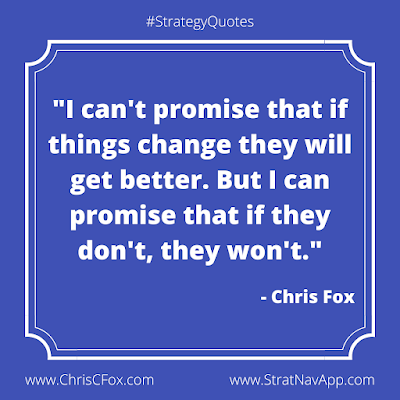
I can't promise you that if things change they will get better, but I can promise you that if they don't, they won't.

Most people don't like change very much.

It can be difficult, uncomfortable, and the outcome is often uncertain.

In fact, as Niccolo Machiavelli said in The Prince: "There is nothing more difficult to take in hand, more perilous to conduct, or more uncertain in its success, than to take the lead in the introduction of a new order of things." (Tweet this)

But, without change, nothing would ever ... well ... change.

Not only might that get a little boring, but, as I always like to say: "I can't promise you that if things change they will get better, but I can promise you that if they don't, they won't." (Tweet this)

On the other hand, too much change leads to change fatigue. People become overwhelmed. They start to lose focus. They start to make mistakes.

So what is the right amount and rate of change? How much change do we really need? How much is too much? And how much is too little?

I draw on Ashby's Law for inspiration.

Ashby's Law (also known as The Law of Requisite Variety) states that: "When the variety or complexity of the environment exceeds the capacity of a system (natural or artificial) the environment will dominate and ultimately destroy that system." (Source) (Tweet this)

It seems we could adapt that to organisation change: "When the rate of change in the environment exceeds the rate of change in the organisation, the environment will ultimately destroy that organisation." (Tweet this)

So, the organisation must change at least as fast the external environment is changing.

That leaves us with three questions:

  1. How fast is the external environment changing?
  2. How quickly is the organisation changing?
  3. How can we increase the rate at which the organisation is changing (if we need to)?

A good SWOT analysis can and should help us answer the first two questions. The Opportunities and Threats will tell you how fast the external environment is changing. The Strengths and Weaknesses will tell you how fast the organisation is changing (or, at least, how fast it is capable of changing).

(See also: 12 techniques to help you do a better SWOT analysis.)

However, measuring the rate of change in an organisation or its internal environment is not an exact science. Some subject comparison will be required. This can be supplemented by gathering feedback from staff, customers, suppliers and other stakeholders.

Increasing the rate of change is even more tricky.

I would advocate the following:

  1. Break the change into the smallest chunks that produce meaningful results as possible. Pursue them, as much as possible, in series, rather than parallel. Smaller chunks are less daunting. Meaningful results create opportunities for real learning  and encouragement to continue. Pursuing them in series rather than parallel limits the amount of change that is happening at any point in time. It also ensures that some results are delivered as quickly as possible.
  2. Be sure to articulate a clear vision about how all of those small changes add up to more than the sum of the parts. People need to understand the logic (the Logos) of what they are doing. Show the individual changes as a roadmap towards the vision.
  3. Create a safe environment for change. Things will inevitably go wrong. A safe environment defines outcomes not in terms of success or failure, but in terms of hypotheses tested, data gathered and learnings achieved. (See also: It's time we stopped idolising failure in innovation.)

If you have other ideas about how to determine and/or increase the right rate of change in organisations, I'd love to hear them. Please drop a note in the comments below.