See also:
- My Slideshare Uploads - there will be more to come.
- Essential Strategy Analysis Tools - for more information about the models and tools in this Slideshare.

I first came across the Business Model Canvas in the book "Business Model Generation" by Alexander Osterwalder and Yves Pigneur.
It is a simple template for describing the various key elements that make up a business model - that is, how a firm extracts value from the markets in which it competes.
The Business Model Canvas is used to describe the following 9 elements of a business model:
Which key partners does the firm rely on, and for what? They could be normal supply, outsource or distribution relationships, but could also include strategic alliances between non-competitors or competitors, and joint ventures. Relationships may be exclusive and tightly contracted or more open market. It is also important to be clear what the firm gains from the partnership that it could not get alone, and therefore how partners are selected and managed.
What key activities must the company perform in order to deliver its value propositions through its channels to its customers? These could include all the activities in the value chain, from product development to manufacturing to sales and marketing and post-sales support, as well as supporting processes such as hiring and developing staff, knowledge management and problem solving, and developing systems. See also How to use Porter's Value Chain Analysis.
What key resources does the organisation need to deliver its value propositions? Key resources can include people and skills, physical assets, intellectual property, patents and copyrights, as well as data, brands and financial resources.
What value does the company offer its customers? Value propositions describe which of the customers' problems are solved using the bundle of products and services a company offers, or which of the customers' needs are satisfied. A competitive value proposition is typically something which is new in the market, or which performs better, is more flexible/customisable, is better designed or is cheaper than what is already available in the market.
What kinds of relationships will the company have with its customers? Customer relationships can offer high levels of personal service, or expect customers to self-serve. Business can be transactional where the customer relationship is limited to the purchase process, or relational, where the customer enters into a longer term relationship with the business. Customer relationships can span the pre-sales, sales and post-sales activities, like servicing, cross-sales and up-selling.
Through which channels will the company deliver its products or services to its customer? This should cover the entire customer process including initial awareness, pre-sales, sales and post-sales experiences. This should include channel mix, multi- and mono-channel strategies as well as channel access and ownership.
What customer segments will the business serve, and equally importantly, which segments will it not actively pursue? Customer segments are distinct customer categories which can be described in terms of what they need from the product or service and how they will use it, how many of them there are, where they can be found and through which channels they can be reached, what kinds of relationships you will have with them, what price they are willing to pay, and, taking all of the above into account, how profitable they are likely to be. See also What is segmentation and how does it work?
What is the cost structure of the business? Costs may be fixed or variable, one-off or recurring, sunk or capitalised, deferred (as liabilities) or contingent (as reserves). Businesses with higher variable costs (relative to fixed costs) typically require less upfront investment and scale more easily, whilst businesses with higher fixed costs typically benefit more from scale. A low-cost business model will require a different cost structure to a high value-add business model.
How much are customers really willing to pay? Revenues can be in the form of a one-off purchase price, or recurring subscriptions, usage or rental income. Pricing can be fixed, variable, or differential. Discounting can be used to encourage specific buyer behaviours.
The Business Model Canvas is typically laid out in the following format:

Business models can be work-shopped by outlining the above template on a large whiteboard, or using brown paper, and then writing short descriptions of each of the business model elements on post-it notes pasted in the appropriate blocks.
The business model canvas can be used to describe and validate a startup, an existing business model or to design one or more future business models or business model changes.
There are two things that are important in the design of a business model. Firstly, it must obviously be both viable and profitable. But secondly, it must be internally consistent. That is, the cost structure must be consistent with the economics of the key partnership arrangements, the cost of performing the key activities, and the acquisition and retention or maintenance of the key resources. These, in turn, must be capable of delivering the value proposition through the customer channels and relationships to the selected customer segments to the extent that they are willing to pay the price built into the revenue structure. In my opinion, it is the assessment of this internal consistency where the Business Model Canvas adds the most value.
The Business Model Canvas is now available in StratNavApp.com, the collaborative online tool for strategy development and execution. The image below shows what a Business Model Canvas (for Airbnb) might look like in edit-mode in the tool (click to enlarge):


Change is like Brussels sprouts, you either like them or you don't, but they are good for you either way. For people who don't like change, organizational restructures are amongst the hardest kinds of change to deal with. But they are both necessary and good for organisations. This blog is an attempt to explain why.
There is an old maxim that structure follows strategy. This means that whenever you launch a new strategy, or evolve an existing one you should be considering a new organisation structure to deliver it. Whilst people are by no means machines, you should no more expect an old machine to produce a new product than you should expect an old organisation structure to deliver a new strategy.
Along a similar vein, I was once advised that, if you want something done, you should put someone in charge of doing it. So if you want a new strategy delivered, your new structure should reflect the new roles responsible for delivering its constituent parts.
So whilst organizational restructures may seem daunting to some, it is worth bearing in mind that trying to deliver a new strategy with an old structure is even more difficult, and unlikely to succeed.
If you were looking for something to make Brussels sprouts more palatable, on the other hand, I am afraid you're on your own - I can't stand them.
Related: organisation Structure is one of the 7 S-es of the McKinsey 7S Framework.
Once you've articulated your strategy, one of the next things to do is to design the organisation to deliver it. This is usually expressed in the form of a Target Operating Model (TOM). A TOM may be for a new organisation you're going to set up, or it may describe the end state for a change programme for an existing organisation.
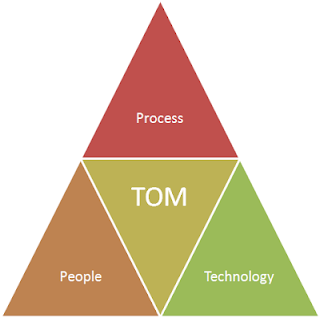
The general approach is to define the people, processes and technology required to deliver the strategy.
The most common approach for identifying an organisation's processes for creating value is to use Value Chain methodology popularised by Michael Porter. This allows you to identify both
Both types of processes may be essential to the delivery of your strategy.
For each process, it is important to understand
Once you've identified and defined your processes, it should follow naturally what people and technology the processes will need.
For each process, identify:
Consider also whether you will need to:
You're then in a position to consider:
Don't forget to think about where the people are or will be physically located, and what implications that might have for your organisation.
Finally, consider the impact of organisational values and culture.
See also:
Technology and systems enable the people to perform the processes.
These include computer systems, manual systems, manufacturing systems and any other supporting technologies.
Do these systems and technologies exist or can you buy, license or rent them? Can you use 'off-the-shelf' systems, or will you have to develop bespoke solutions especially for your business? The more differentiated your processes are the more likely it is that you will need bespoke solutions, or that pre-existing solutions will need extensive customisation.
How will you integrate and maintain these systems? You should be able to map this back to your process view.
There are a number of different ways in which you could extend this general people-process-technology approach.
Firstly, you could go beyond the convention of considering just people and technology. For example, you could consider all 7 dimensions encapsulated in the McKinsey 7S analysis. People or Staff and technology or Systems are two of the 7 Ses. McKinsey 7S does not emphasise the process dimension.
Secondly, you could adopt the POLISM model developed by Andrew Campbell, and others, at Ashridge Business School. POLISM stands for Process (or value chain), Organisation, Locations, Information Structure and Management system. This gives more prominence to location and suppliers. It considers information and management systems more explicitly than it does technology.
Andrew then went on to propose an integration of the POLISM model and the Business Model Canvas. I have previously written about this in Introducing the Enhanced Business Model Canvas.
Your strategy implementation plan needs to consider all of the implications of the above:
Designing a TOM is a significant piece of work. But, the real challenge lies in developing and implementing a TOM which actually
StratNavApp.com is the online collaborative tool for strategy development and execution. It integrates all of the tools mentioned above: Porter's Value Chain, including Process, People and Technology, McKinsey 7S, and the Enhanced Business Model Canvas. So it can help you develop your Target Operating Model. It is free to use, so go ahead and give it a try.

