StratNavApp.com banner ad
Showing posts with label marketing. Show all posts

Experience trumps promotion

Some years ago, I wrote about a positive experience I'd had as a regular flier on British Airways, and how I suspected it had been part of a well-executed campaign. You can read the post here: British Airways just made my day.

More recently, I met a lady who'd worked in British Airways's marketing department around that time, and so I asked her about it. Her response slightly surprised me: "How did you know about that? We didn't really promote that campaign."

In marketing, it is easy to get so caught up in what we tell customers about our company / product / service, that we forget that what matters so much more is what they actually experience.

The holy grail, of course, is for the two to align completely: for the marketing message to help existing customers to better describe the experience they had, and to help new customers look forward to the experience they will have. And we all know what happens when the marketing message promises more than the experience delivers: disappointment and mistrust.

British Airways delivered me an experience that made me feel even better about being a regular customer. That they did it without fanfare probably made the experience feel even better.

photo credit: BriYYZ via photopin cc

What is segmentation and how does it work?

Segmentation is not about putting customers into neat little boxes and hoping they will conform. Customer are individuals, and diverse. Their behaviours and preferences are circumstantial and may change for indiscernible reasons.

Segmentation is about designing and bringing multiple unique and differentiable propositions to market. ‘Customer segments’ are a tool to aid in this process.

Segmentation increases customer choice, thereby increasing customer value. Customers may choose one or more of the propositions, and their choice may change over time. Segmentation is the antidote to the ‘one size fits all’ syndrome.

Differential pricing is a method for increasing the amount of value you can extract from the market by charging more to those who are willing to pay more, and less to those who are not. However, differential pricing is only sustainable where other forms of segmentation are working effectively.

Is transparency enough?

Last night's Panorama investigation into pension fund charges, and this article in the Telegraph, have once again shone the spotlight on fund charges.   The conventional wisdom seems to be to push for greater transparency in fees.   I'm all for that - but I am not sure it will be enough.

Knowing what fees you're being charged is one thing.   But I don't believe that the average investor is able to fully understand the impact those fees have on their pensions and investments.   It takes a fair amount of sophisticated maths to calculate the fee drag on £100 a month invested with a 1.25% management charge, not too mention any other charges such as dealing and custody charges that may be thrown in on top.

I believe a better solution would be to force all funds to report performance after all costs have been taken into account.   The equivalent of an APR calculation for fund performance, if you like.   That way, investors would be better able to assess whether their pension fund had performed better than their cash in the bank over the last year.

(Where a fund changes its charging structure, the rules could be such that the fund would also have to restate its historic performance as if the new structure had been put in place.)

Of course, that provides a backward looking view only.   So we'd still need all the transparency in order to formulate a forward looking view.   However, I believe it would put the average retail investor in a much better position to assess whether they felt they were getting value for money.

What do you think?

Social Media in Financial Services (or at least #SocialMediaFS)

I was not fortunate enough to attend the the Social Media in Financial Services conference in London today and yesterday.   However, it being a conference about social media, we were all very fortunate to have so many delegates tweeting (or is it twittering) the conference highlights throughout the day using the hashtag #socialmediaFS.

I certainly got enough material from this during the two days to warrant a blog post.

Although I am naturally going to try and pull the nuggets out that have the most strategic significance, a conference or a post on social media in anything would not be complete without a definition of what social media is.
RT @TheFinanceCoach: Social media is simply digital word of mouth #socialmediafs
That's about as simply as you could put it.   Almost too simple to be worth mentioning.   Except to the extent that some many people just don't get it.   You hear constant criticism of services like Facebook.com and Twitter.com because some people will insist on updating their status to tell the world what they had for breakfast that morning.   And yes, as far as I am concerned, that is a waste of time.   I've also recently heard Twitter.com demonised because two people who conspired to murder had used Twitter.com to discuss their plans with each other (which, in hindsight, I am sure they regret).

But you don't hear those same criticisms levelled against the telephone.   I am sure that more people have discussed their breakfast on the telephone than have on Facebook, and I am equally sure that more murders have been discussed on the telephone than have on Twitter.com.   Word of mouth can be either helpful or not helpful.   If you don't want to know what people have for breakfast, simply tune out people who post about that, and tune into people who post content you find more interesting.   (I will confess to filtering out real world friends on Facebook because I don't like their Facebook posting style).

Social Media just makes word of mouth more powerful.   And if word of mouth is the most influential way of spreading your message, then you surely need to pay attention to the most powerful tools for doing so.
RT @PeteMatthew: 92% of people trust word of mouth as the best source of new product ideas. 62% consult online communities before buying ...
(If you still want a more full definition of Social Media, I'd recommend The Evolution of New Media, Web 2.0, Social Media, Social Business: A Brief History of Everything)

So, if social media is important, what can companies do about it?
RT @crispinheath: The three most powerful ways of using social media - marketing, communicating and creating community #socialmediafs

 There are, of course some differences.
RT @PeteMatthew: Social media replaces the physical things we use to promote ourselves; car, clothes etc now replaced by Websites, SM #S ...
One of the key differences is that what you say digitally and publicly with social media tends to stick longer than what you way around the water cooler at the office.   Your comments become artifacts.   People who interact with you online but meet you only infrequently, or possibly even never, form judgments about you based on those artifacts.   And so it becomes important that everything we put out there is consistent with the image we are trying to portray.
RT @crispinheath: Nicola Webber 'Every post is an opportunity to build your brand' very true #socialmediafs
It could equally be said that every post is an opportunity to destroy you brand.   The internet abounds with stories of people who've damaged their reputations, destroyed relationships or lost their jobs as a result of injudicious post of Facebook.com or Twitter.
RT @TheFinanceCoach: It takes twenty years to build a reputation and 5 minutes to ruin it. Warren Buffett #socialmediafs
Even so, even bad publicity on social media can be put to good use:
RT @TheFinanceCoach: Resist the temptation to delete something negative that a client says. Use it as an opp to interact #socialmediafs
What is true at a personal level is as true of corporate brands.
RT @PeteMatthew: Be single minded about your brand: communicate one thing in one way, in every sphere.#SocialMediaFS
The power of social media makes it possible for individuals and companies to desiminate more information and to have that information spread more rapidly and more widely than at any time in history.   And that is a double edged sword.   Too much information with too little focus can confuse your audience and do more harm than good.   Social media increase the importance of focus in your communication message.   And focus in your message is very hard to achieve without strategic focus and differentiation.

However, social media also means that it is not longer sensible not to communicate.
RT @bClear: while you're not communicating with your clients, everybody else is #socialmediafs
Customer engagement is fast becoming a key strategic enabler.   Its not a strategy in itself.   You still need a strategy with which to engage your customers, suppliers, distributors and other stakeholders.   But increasingly the companies with open two way channels of communication have access to levels of understanding of the needs and wants of their customers that give them a distinct advantage in formulating and executing successful strategies.
RT @martinskinner: "The ultimate downfall of big co's will b that the highest paid staff r typically the furthest from the customer @tho ...
The ability of small companies to engage directly with large numbers of customers and partners on a cost effective basis has largely eroded one of big companies' previous advantages - large research and development budgets. Small companies are now able to gather information directly from customers on a near-continual basis and incorporate that into continually evolving product and service designs. If they are more nimble than their larger competitors, this may enable them to outcompete them.
RT @topleftdesign: #socialmediaFS: @ThomasPower "its not the early adopters who spend the money - but they tell their mates and spread the word
Word of mouth works both ways of course. Not only is it the most important channel for getting customer feedback, it is also the most effective marketing channel.   The subject of how to get social networks to spread your marketing message is one of the most hotly debated topics in the marketing discipline.   I've posted about viral marketing and viral business models before.   The simple fact is, if you want people to spread your message, give them a message that makes them look good to their network.
RT @PeteMatthew: 'If I tell my Facebook friends about your brand, it's not because I like your brand, but because I like my friends' #So ...
In some ways, this turns marketing on their head. Marketers need to think not "what do we want people to tell their friends?", but "what do people want to tell their friends?" Often this involves giving away an awful lot before you expect to get anything in return.

One of the reasons big companies may not embrace social media is that, in order to succeed, they have to give up the control they've tried so hard to establish.
RT @davidricketts: Firms have to accept they have little control over what is said about them when using social media#socialmediafs
Moving on to financial services, more directly, the EngagementDB's July 2009 ranking of the top 100 global brands cites financial services as the industry sector with the lowest levels of engagement.   Other industries with similar levels of regulation have done better.
RT @crispinheath: 35k docs active on doctors.net.uk Doctors logging in 45 times a month and spending 25 minutes a day. Incredible nos. ...
This lack of engagement in the financial services sector creates a real opportunity for improvement.

I've also posted before about developments in Personal Financial Management.   In the UK, we (driven by the FSA?) tend to focus on financial education.   Sure, that may be what people need.   But is it what they're going to want to tell their friends about?   It will almost certainly take more to get people excited enough to pass the message on either down at the pub or through social media.
RT @PeteMatthew: Clients don't want a map for their financial journey, they want a satnav giving real-time directions:@mikelinskey #Soc ...
Sadly the UK market has been very slow in picking up on this despite numerous examples we could draw on from across the ocean.
RT @PeteMatthew: America is light years ahead of us in delivering Financial Advice online. See Mint, SmartyPig and Cent ...
Finally, no conference would be complete with a dose of interesting statistics.

I am constantly amazed by the number of executives who refuse to engage in social media and label it as the domain of impoverished students and school children who offer little commercial prospect.
RT @bClear: fastest growing sector of people using the internet are aged 35-54 #socialmediafs
There are plenty of statistics showing that social media is also incredibly popular in this age group (for example).

I was slighltly more surprised by these figures:
RT @crispinheath: Robert Pink '49% of general insurance iis bought online, 51% of car insurance bought online'#socialmediafs
Frankly, I thought they'd be a lot higher, given how easily comparable general and car insurance is, and how many discount and online brokers, supermarkets and price comparison web-sites there.   It is perhaps a sobering message for for social media enthusiasts.   Whilst the online market, those reachable through social media, may be by far the fastest growing segment, the offline segment remains substantial.

Which brings me to my final and equally but oppositely surprising statistic:
RT @PeteMatthew: Google UK. 25% of folks' leisure time is now spent online. #SocialMediaFS
I find it quite hard to believe that the figure is really that high.   Whether it is or isn't, it does highlight another danger of social media:   in a world where everyone is a publisher, and fact checkers are a luxury only the large publishers can afford, you can't believe everything you read online.   Its long been true of the internet, and even of traditional media, that you can't believe everything you read, but social media makes it easier for errors to enter the published domain, and easier and faster for them to spread rapidly.   It could be that the Google presenter got his facts wrong or mis-represented them, or that @PeteMatthew misheard or mistyped them, or that I miscopied them.   But the fact remain, that that figure is now permanently recorded in both his tweet and this blog entry.   On the other hand, if the figure is right, then the world has changed more and faster  than I had ever imagined.   (If anyone can verify this figure, please post a reference in the comments below.)

Perhaps I will get the opportunity to attend next year.

See also:


Management Gurus

Here is a list of Management Gurus worth familiarising yourself with:
Please feel free to add your own recommendations in the comments.

Natural History - Inside Out

Museums, like everyone else, must struggle to remain relevant in the face of rapidly changing consumer preferences. The new Darwin Centre at the Natural History Museum in London does an examplary job by turning the museum inside out. The new exhibit focuses, not on the animals, minerals and vegetables that are the focus of all of its other exhibits, but on the work that the scientists do behind the scenes. The centre contains exhibits describing the scientists' work, but more significantly, windows into working scientific laboratories where you can watch the scientists at work and even interact with them.

I was there today with my parents and my three year old daughter. Imagine her delight when she spoke to the scientist behind the glass window and he answered her in an engaging and enthusiastic manner. Most of what he said would have been lost on her young mind (but not to the rest of the party), but I am sure that this real life and personal exhibit will have made a greater impression on her than all of the other interactive exhibits put together.

As businesses struggle to adapt to an environment where customers are increasingly disinclined to be treated as faceless members of categorised target markets, they could do worse than to study the way in which the Natural History Museum has turned itself inside out and exposed its inner workings to the public.

Oh, and thanks to all involved for a thoroughly informative and enjoyable day out.

The Bambinoccino

The Bambinoccino must be one of the best marketing concepts I've seen in a long time.

For those of you who don't know what a Bambinoccino is, it is essentially an espresso cup filled with cappuccino froth with a sprinkle of chocolate powder. Or, put another way, a cappuccino without any coffee. It's mostly air.

It is sold by Pizza Express as part of its kid's menu.*

Strategic insights

The success of the Bambinoccino rests on a few strategic insights:

  1. Product margins: I heard somewhere that coffee is one of the highest margin sales for restaurants because it is relatively cheap to make and serve. So you really want customers to buy one at the end of their meal.
  2. Target demographic: One of Pizza Express's core demographics is families with small children. Now, most often, when eating out with small children, after dinner coffees are sacrificed in order to make a quick getaway before the children, having finished their food, start to get bored. So the high-margin coffee sale is lost unless you can find something else to keep the children happy. But, when the Bambinoccino arrives at the end of your kids' meal, you may as well have a coffee yourself while you wait.
  3. Buyer values: There is nothing that small children enjoy more than pretending to be older. So enjoying a Bambinoccino at the end of their meal "just like mummy and daddy do" is a source of great pleasure. (The fact that theirs is missing the actual coffee is not an important detail.) And happy children make for happy parents. A free Bambinoccino keeps the children happy whilst their parents enjoy the high margin coffee - and would could be better for a small child than drinking an after dinner "coffee", just like their parents do!?
  4. Branding: They could have just called it "frothed milk". But that would have seemed 'odd'. Perhaps even a bit of a rip-off. Giving it a cute name helps maintain the illusion for the kids (it sounds like what the parents are drinking**) and is more likely to get the parents talking about it. Same product - different name makes all the difference.

Lessons for business strategists

  1. The small things matter. Strategy isn't just about the high-profile things. Of course, Pizza Express should be worrying about supply chain management, purchasing, staffing and training, restaurant locations, etc. And I am very sure that they are. The Bambinoccino is one of the those simple and cheap ideas which helps to maintain the integrity of the customer experience, and keeps people coming back. It requires no extra raw materials and no new equipment. They already have those for making cappuccinos. It is a (nearly free) by-product, put to good effect.
  2. Insights don't need to be complex or profound. None of the insights listed above are. It's more often the combination of insights than the individual insights themselves that make the difference.
  3. You can find a lesson about business strategy just about anywhere. Even in a cup of coffee at the end of a meal with your kids at Pizza Express. So keep your eyes peeled at all times and keep learning!

* Since writing this post, I believe a number of other chains have started to offer similar products.

** I've seen other brands call their product a babyccino. I am less convinced by that. How many small children want to be told that they are babies?

Addendum 2023

Apparently some coffee shops (e.g. Starbucks) are now selling puppuccinos - frothed milk or whipped cream for your dog!

Mint marketing gets it right

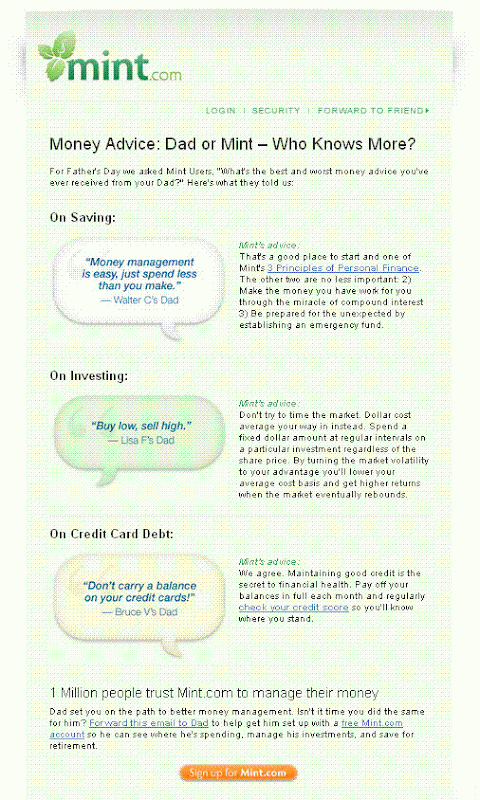
Mint.com's fathers day campaign is an effective combination of Twitter, E-mail and their web-site.

A few weeks ago, the Personal Financial Management ("PFM") web-site, Mint, asked people (via Twitter) to send in the best and worst financial advice they'd ever received from their father (as part of a fathers day theme). You could then watch customers replying on Twitter.

This morning, I received this e-mail from them (I hope Mint will not object to my reproducing it - if they do, please let me know):


I apologise for the fact that it is not very legible.

There is nothing complicated in it. However,
  • it provides an opportunity for contextual links back into parts of the site ("3 principles of personal finance" and "check your credit score")
  • it has a real sense of community ownership - this is the content that we helped create, Mint listened to us and did something about / with what we said, Mint is in tune with our lives (in a very personal family values oriented manner). It does not matter if it is somewhat manufactured in between the Twitter feedback and the e-mail - the people who took part will still recognise their participation, no matter how tenuous.
  • it has a slight but very clever viral element ("forward this e-mail to your dad") to help spread Min't promotion reach across the generational divide. There is a mor generic "forward this to a friend" link at the top, butI think that the more personal "forward this e-mail to your dad" will achieve more resonance given the topic of the e-mail and the fact that they sent it two days before fathers day.
I think that this is an all-round well executed campaign, combining context, community, viral elements and strong clear calls to action.

The difference between Viral Marketing and Viral Business Models

It's every marketer's dream to "go viral".

However, "viral" can mean two quite different things.

Viral marketing
The first meaning of "viral" is probably the most familiar as it has been around longer. Viral marketing refers to a marketing message which spreads within a community under their own volition (as opposed to one which must be broadcast by its sponsor).

Wiktionary defines
viral marketing
as:
A technique aiming at reproducing "word of mouth", usually on the internet or by e-mail, for humorous, political or marketing purposes.

Some recent examples include:
  • Samsung's Extreme LED Sheep Art video: disconcertingly mesmerising, your guard will be down before the subtle product push appears right at the end.
  • CompareTheMarket.com's CompareTheMeerkat.com: so subtle that many people I've spoken to had not realised it was a CompareTheMarket.com add despite the CompareTheMarket.com name, logo and URL appearing at every conceivable opportunity.
  • The Large Hadron Rap: a brilliant effort to make something extremely complicated, buried underground and with the potential to destroy the entire universe both understandable and cool.
The objectives of viral mareting are simple:
  • to increase awareness,
  • at a lower cost (certainly much lower than a conventional above-the-line advertising campaign),
  • to have some of the campaign attributes ("coolness", innovation, etc.) rub off on the brand (although P.T. Barnum supposedly suggested that "There's no such thing as bad publicity", a viral marketing campaign must surely aim for "good" publicity!), and
  • to get customers involved in spreading the message themselves, which subconsciously increases their comitment to the brand.
Dan and Chip Heath have outlined their three secrets to make a message go viral. To summarise, these are:
  1. it's emotional,
  2. it feels like you're doing someone a favour by passing it on, and
  3. if contains a trigger to pass it on.
Viral business models
Whereas in viral marketing, it is only the marketing message that is viral, viral business models exhibit viral growth as an inherent part of the business model. That is, as a part of their normal interaction with the business, its customers publicise the business to others and/or invite them to become customers themselves.

Examples of viral business models include:
  • Social Networking sites, such as Facebook, LinkedIn, and Twitter: There is no little to membership unless you friends or business contacts are also members, so each member is highly incentivised to encourage others to join. Further, once most of your friends or business contacts are members, you're undera lot of pressure to join up or risk being "left out".
  • Remote multi-player games and consoles: As with social networking sites, there is pressure to buy the same games and console that your friends have so that you can play along with them.
  • Peer Review sites, such as Amazon.com or Amazon.co.uk: These are similar to Social Networking sites, in that the more members there are (and are rating and reviewing the product), the more value each member gets. However, since you don't need to have any relationship to the other members, there is less incentive for you to sign them up - you simply gravitate to the site with the most existing and active members.
  • Multi-level marketing (MLM) or Network Marketing businesses: Not always popular and sometimes bordering on being pyramid and/or Ponzi schemes MLMs succeed by incentivising their members to recruitmore members.
  • Services that advertise themself when their customers use them to share their own content, such as free e-mail providers (gmail.com), blog hosts (blogger.com - visible at the top of this blog post), content sharing sites (youtube.com - used a few times in this post; and vimeo.com - also used in this post) all of which advertise themselves in their URLs if not more overtly.
In his review of Product Planner, Jason Kincaid suggests that the key to creating a viral business model is to create a circular process where by each activity in the cycle involves promoting to or inviting additional users. This process can be the member enrolment process itself, but its even better another process, such as the video embed loop at Vimeo, as the customer will have multiple opportunities to publicise the business and/or invite new members as their familiarity with and confidence in it increases (people are more likely to want to recomment something with which they are familiar than something which is still new to them).

Viral busines models tend have "tipping points" - points at which the adoption rates change markedly. These can be hard to predict. For example, in we were so wrong about Twitter, Rob Diana, suggests that one of the tipping points for Twitter was the adoption by celebrities such as Ashton Kutcher, Britney Spears and Oprah.

The difference between these two meanings of "viral" is significant in its application to businesses. Any business can create a viral marketing campaign. All you need is a sufficiently talented creative team (how about the viral factory and their wikipedia page), and, perhaps, a bit of luck. (That is not to imply that it is easy!) However, a viral business model needs to be built into a new business from the outset, or will require significant business re-engineering to implement into an existing business. I'd hesitate to say anything is impossible, but some existing businesses simply won't lend themselves to viral busines models.

Related articles