
StratNavApp.com banner ad
Showing posts with label risk. Show all posts

Should business strategists have foreseen COVID-19?

The answer is: Yes.

But the aim of this article is not to lament what we should have done. Nor is it to crow about what we did do. Instead, it is to consider what we should do going forward.

One of the roles of strategy is to help businesses to be successful into the future. And we must do so for whatever the future brings. When something like COVID-19 comes along, we can't simply excuse ourselves for not having prepared for that future.

Now, I am not suggesting that any business strategist should have predicted exactly what happened.

For example:

  • that a virus would emerge from Wuhan in late 2019/early 2020,
  • that it would evolve into a pandemic and shut large parts of the world down,
  • that it would overburden most countries healthcare systems, and
  • that government would respond by locking their populations and economies down.

What could we have foreseen?

But there are many aspects of COVID-19 which were easy to foresee. These include, for example:

  • a pandemic,
  • a global economic downturn,
  • the failure of stretched and global supply chains, and
  • remote working.

These are things we've talked about in the past at length. We've even experienced these before. Perhaps not in our own lifetimes. And of course, each time they happen they're different.
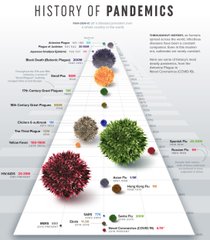
We've had pandemics in the past. (You can click on the chart to the right to see it in more detail.) This 2015 Ted Talk by Bill Gates is one of many warnings of what future pandemics might be like. And we've long been aware of emerging strains on our health care systems posed by things like:

  • population ageing and
  • antibiotic-resistant diseases.

Likewise, we've had global economic downturns in the past. Arguably, as recently as 2008. Some argue that this one will be deeper and longer than any we've encountered to date. But even so, that possibility is not hard to imagine.

We've been worried about the impact of globalisation. Be that on the distribution of wealth or on the environment. We've also worried about possible disruptions to stretched global supply chains. Even if that concern was more fueled by concerns over a trade war between the US and China than by concerns of a pandemic.

And we've been debating the pros and cons of flexible and remote working for years. Until now, the status quo has conspired against them. However, in London, for example, the Olympics (see here), as well as numerous train strikes, have offered regular glimpses of the need for greater flexibility.

Our job as strategists is not to be experts in all of these fields. But we should be aware enough of the possibilities to help our organisations to understand and prepare for the specific consequences they might bring.

What should we do?

There are three steps to be prepared:

  1. Be aware.

    The first step is to be aware. If we're not watching those Ted Talks, studying that macro-analysis or reading those risk reports then we won't know what's out there.

  2. Consider the impacts.

    Then we need to consider the impacts these things might have on our businesses. Each business is unique. And the so the impacts on each business will be different.

    Consider, for example, how different the impacts of COVID-19 have been on hotels, airlines, restaurants and the highstreet, contrasted against the impacts on firms like Amazon, Ocado and Zoom.

  3. Integrate this analysis into our planning and execution processes.

    If our planning processes amount to simple extrapolations of last year's budget into next year's budget. COVID-19 highlights the significant uncertainties we face. And this underpins the importance of integrating scenario-based analysis and planning. (See: Scenario Planning: A Practical Guide for Navigating Uncertainty).

    Once the planning is complete, the results need to be built into your execution processes. Early warning systems need to be put in place. Responses need to be rehearsed. Capacity for rapid change needs to be built.

What are the challenges?

Typical short-comings I have encountered in trying to achieve this include:

  1. Fatalism: Decision-makers conclude they can't predict or avoid crises. They call them 'black swans' and place them outside the bounds of normal logic. As a result, they can't or don't know how to prepare for them. Ultimately, they conclude that they're better off just ignoring the possibility.

    It's true that you might not be able to guarantee that the Titanic would be unsinkable. But you could make sure she carried enough life-boats.

  2. Theorism: Decision-makers engage in the analysis. But this fails to progress beyond being an "interesting exercise". Once it is complete, everyone goes back to their desks and carries on as before.

    The only thing worse than facing a crisis with your head buried in the sand is facing it with your eyes wide open and in the full knowledge that you failed to prepare.

  3. Optimism Bias: This is the expectations that whilst bad things do happen, they won't happen to me. The best time to repair your roof is when the sun is shining. But that's also the time when the need to do so seems less pressing.

    When times are good, we fail to prepare for when they are not. And by the time they are not, it is often too late. Running cash reserves and building redundancy into your processes and supply chain seems like an unnecessary waste during the boom years.

We don't know how and when the COVID-19 crisis will end. So far, most businesses have been very reactive. Just trying to survive. But sooner or later* businesses need to start looking forward and preparing to succeed in the future. Whatever that may be.

*I would strongly suggest sooner.

Strategy Risk: The Importance - Attention Matrix

One of the biggest strategy problems is to fail to pay attention to the right things.

If you map the relative importance of issues to your strategy against the relative amount of attention they receive in the organisation, as shown to the right, you get three outcomes:
  1. Risk arises where issues which are strategically important receive inadequate attention
  2. Waste arises where issues which are not strategically important receive too much attention
  3. Performance occurs where all aspects of your strategy receive the right amount of attention, be that a lot or a little.
Consider the situation encountered in many mature organisations. The accountants take over, and financial matters get more attention than they need (sometime resulting in financial over-engineering problems and financial risks). In the meantime, in those organisations, customer issues often get very little attention, even as the organisation's customers' start to look elsewhere, exposing the business to strategic risk.

On the other hand, in entrepreneurial startup organisations, the organisation often focuses overly much on customer related issues, with inadequate attention to financial issues, and so runs into cash flow or debt issues. Alternatively they fail to pay sufficient attention to process, and run into problems with scalability once the business takes off.

Part of a strategists role is draw people's attention to the right balance of what requires attention. Unfortunately this often means calling attention to future challenges while the present seems very rosy. This can lead to the Cassandra effect - where your attempts to look to what is important for the future are doomed to be ignored in favour of what is currently attracting attention. In these circumstances, careful stakeholder management is required to take key stakeholders on a journey from what they're currently paying attention to to what they should be paying attention to.

The World Economic Forum's Global Risk 2013 report

photo credit: World Economic Forum via photopin cc
The World Economic Forum released their 8th Annual Global Risks report this week.

The executive summary outlines 3 key global risk scenarios, which I've paraphrased here:
  1. Testing Economic and Environmental Resilience: We continue to push our economic systems and the environment to its limits. A simultaneous shock to both could create the perfect storm and overwhelm both.
  2. Digital Wildfires in a Hyperconnected World: The rapid and widespread dissemination  of misinformation could result in a global panic - the dark side of the rapid growth of social media and the democratisation of mass communications.
  3. The Dangers of Hubris on Human Health: Recent advances in healthcare may have lulled us into a false sense of security, even as we approach the limits of our existing approaches to combating ever mutating threats.
How much attention you should pay to global threats of this nature depends on what kind of organisation you are. Clearly, if you're a global bank, insurer or health care concern, these should be near the top of your agenda. However, if you're a corner fish and chip shop, there is probably not much you can do about these issues and so there is not point in wasting too much time worrying about them. For most of us, the challenge is working out where we fit between those two extremes.

Control Processes in the Strategic Learning Cycle

Once you've articulated your strategic vision, objectives and values, and crafted your implementation plan of action, the fourth phase in the Strategic Learning Cycle is to control your execution.

The strategic control framework usually consists of 4 components:
  • Measurement: the first level of control is to measure whether you are achieving your strategic objectives - see How to measure success against strategic vision and objectives . Measurement also provides the data on which the other 3 components depend.
  • Risks and Issues Management: your measurement system should help you to monitor the risks to your strategy and identify any issues as early as is possible.
  • Feedback: identified issues provide feedback. The Strategic Learning Cycle provides 2 feedback loops. The first loop returns to planning and implementation - plans are adjusted and efforts are redoubled, but the strategy itself remains unchanged. The second feedback loop returns to analysis - if the conditions on which the original analysis was based are found to not have been true or to have changed, then reworking the analysis may lead you to change the strategy itself.
  • Governance: finally it is important to have a good governance framework in place. This ensures that the right information reaches the right people at the right time, and empowers those people to use it to make decisions in a suitably transparent manner. (By contrast, poor governance suppresses or obscures information and allows decisions to be made based on special interests.)

How to tune and prune your portfolio of strategic initiatives

Once you've determined your portfolio of strategic initiatives, either as part of a new strategy you've developed, or just by listing out the initiatives currently underway within the organisation, you're in a a position to review them with a view to prioritising them and/or assessing their efficacy. The framework below provides a suitable basis for doing so. (You could, and probably should, also use a 4 Horizons analysis for this purpose.)

Diagram showing a framework for strategic initiative portfolio analysis.
By mapping your strategic initiatives out in this way your are able to evaluate your portfolio of initiatives according to three success criteria.

Firstly, have you got an even spread from low hanging fruit to strategic transformations? If you have only initiatives in the strategic transformation quadrant, you organisation is likely to stagnate during the short-term as the strategic transformation initiatives are likely to take a long time to bear fruit. Unless your organisation has very deep pockets, such a short term stagnation could place a strain on its cash flow and customers' loyalties. By including some "low hanging fruit" initiatives, you're likely to see earlier gains. This is also likely to boost staff morale and buy-in to the overall strategic change programme.

On the other hand, if you have only initiatives in the low hanging fruit quadrant, your organisation may be lured into a false sense of security, only to be toppled as significant environmental changes occur or your competitors implement step changes in their own strategies.

Secondly, are you continually challenging the innovators within your organisation to imagine the golden opportunities - those opportunities that produce disproportionately high benefits relative to their costs, risks and difficulty of implementation? By continually challenging your organisation to do so, your will hopefully move your portfolio upwards and leftwards on the grid over time.

Thirdly, are you successfully avoiding projects with a low cost-benefit ratio? These tend to be the pet projects of key decision makers and/or resource allocators - although they are sub-optimal relative to the rest of the portfolio they are pursued on irrational grounds based on personal agendas. These should be eliminated. This may need to be done carefully so that the people with vested interests in these initiatives do not become alienated from the rest of the strategic change programme. However, it is important that this entire analysis is done on the basis of sunk costs - that is sunk costs should be ignored from the costs side of the analysis. A project that started out as a pet project but which has already spent 90% of its costs may now be low hanging fruit if you believe all of the benefit are still attainable for the cost of only 10% of the initial costs. Clearly you can't get the 90% of costs already spent back, but you should consider them a valuable lesson in the importance of avoiding these kind of projects in the future.

As you get ready to kick off your strategic planning process for the year, this may be a great opportunity to evaluate your existing portfolio of strategic initiatives with a view to pruning it and developing it forwards. Please let me know how you get on in the comments below.

Thorough, but safe

I was asked to review the strategy of a well established firm earlier this week. The headline of my review feedback was 'thorough, but safe'.

'Thorough' referred to the quality and depth of their strategic analysis. They'd collected a lot of data on almost every aspect of their business and its competitive environment, they had analysed it thoroughly and presented it in a meaningful narrative. So far, so good, I thought.

But then they went 'safe'. They concluded, at the end of the analysis, that the impact of all of the threats and opportunities they'd identified would probably be minimal. They suggested, that despite all the trends and change they'd analysed, things would basically continue as they were.

As a result, their strategy was broadly to carry on doing what they were doing, and to hope that they could pick up a few points of market share if any of their competitors slipped up in any way.

Playing it safe is a great strategy in a safe industry. The trouble is, I've never really encountered a safe industry, and this certainly wasn't one. Playing it safe is fine if all of your competitors are also playing it safe and your customers are happy. But they are not: your competitors are out to destroy you; your customers are rapidly becoming bored of your product and looking around for more. Like a shark, if you stop swimming, you die. (Yes, I am aware that is not quite true of sharks, but it makes the point, I think.)

It struck me that even if this executive team thought that there would be no significant impact from the many threats and opportunities in their competitive environment, shouldn't they at least consider what would happen if there was? Shouldn't they at least put contingency plans in place for what they would do if things did change? Shouldn't they plan for a preemptive strike before their competitors went after their market share? Shouldn't they surprise their customers with some new innovation before they get the chance to get bored with what they're already getting? Shouldn't they do something - anything - other than just playing it safe?

Coincidentally (or perhaps synchronistically) I came across this TED Talk this week as well. It's worth watching Seth Godin explain why 'safe' is the new 'risky' and why it is necessary to be 'remarkable'.

Project management lessons from investment management

In ROI: Risk of Ignoring, I started to explore investment management as a metaphor for strategic project management. Here are some more lessons from investment management:
  • Risk / Reward: it follows, I think, that the projects with the greatest potential risk for failure carry the greatest potential rewards (all other things being equal). In traditional finance theory, advisors establish the risk tolerance of a client. Organisations too have a project risk tolerance. Conservative companies are just not that good a high risk projects - which goes a long way to explaining the relatively low levels of innovation (historically) in the financial services sector compared to the dot com sector, as well as the re-invention of big pharma.
  • Diversification: particularly at the higher risk end of the spectrum diversification pays - that is running a portfolio of projects whose failure points are not correlated dramatically increases the chances of success. In organisational terms, that means not focussing all of your innovation and investment in one division or area of the business at the expense of the rest. It also warns those business who pin their hopes on a single transformative initiative. (On the other hand, people can only deal with so much change at a time, so that needs to be managed too.)
  • Profit Taking: with investments, it makes sense to sell investments once you've made a respectable profit, rather than hanging on for the investment to peak, thereby leaving something on the table for the next investor. Similarly, it make sense to get you products out there before they have every last feature implemented. It's better to get something out there than it is to wait until the market turns and someone else has mopped up your target market.
  • Liquidity: investments that are easy to monetise are more attractive than those that are not. Look for project structures that are easy to disaggregate into pieces that are easily repurposed or multi-purposed. Look for early wins that impact the bottom line. This is why Agile methods have become so popular.

Risk profiling and asset allocation - is there a better alternative

One of the things I've been worrying about lately is whether or not there are any viable alternatives to the traditional approach of risk profiling and asset allocation.

There are, of course, a number of well documented shortcoming with the existing approach (see, for example, McCrae's research: Profiling the Risk Attitudes of Clients by Financial Advisors: The Effects of Framing on Response Validity.   I am assuming that we're talking about a robust approach to risk profiling and asset allocation, based on a reasonably accurate "attitude to risk" profiler, incorporating goal specific information and timelines (capacity for risk), thorough analysis of efficient frontiers, and regularly reviewed and adjusted.   (Any approach that ignores those factors is bad, without detracting from the underlying principle.)

The main criticism that I encounter is that risk profiling questionnaires are inaccurate.   That is obviously true.   What you really want to now is what is the customers optimum trade off between risk and return.   But given that most customers don't understand return (many don't even understand percentages) or risk (even fewer understand probability, let alone probability distributions), it follows that you have to settle for the closest approximation of this that you can find - which will always be slightly inaccurate.

A number of improved approaches have been suggested, for example:
However, these all seem to be based on finding an improved way of presenting risk profiling and portfolio selection processes to the customer, and don't represent alternatives to the basic underlying concepts.

So it seems to, that despite its failings, there is no real alternative to risk profiling and asset allocation, and the best we can do is to strive to improve our tools for performing the existing process.