StratNavApp.com banner ad

The Bambinoccino

The Bambinoccino must be one of the best marketing concepts I've seen in a long time.

For those of you who don't know what a Bambinoccino is, it is essentially an espresso cup filled with cappuccino froth with a sprinkle of chocolate powder. Or, put another way, a cappuccino without any coffee. It's mostly air.

It is sold by Pizza Express as part of its kid's menu.*

Strategic insights

The success of the Bambinoccino rests on a few strategic insights:

  1. Product margins: I heard somewhere that coffee is one of the highest margin sales for restaurants because it is relatively cheap to make and serve. So you really want customers to buy one at the end of their meal.
  2. Target demographic: One of Pizza Express's core demographics is families with small children. Now, most often, when eating out with small children, after dinner coffees are sacrificed in order to make a quick getaway before the children, having finished their food, start to get bored. So the high-margin coffee sale is lost unless you can find something else to keep the children happy. But, when the Bambinoccino arrives at the end of your kids' meal, you may as well have a coffee yourself while you wait.
  3. Buyer values: There is nothing that small children enjoy more than pretending to be older. So enjoying a Bambinoccino at the end of their meal "just like mummy and daddy do" is a source of great pleasure. (The fact that theirs is missing the actual coffee is not an important detail.) And happy children make for happy parents. A free Bambinoccino keeps the children happy whilst their parents enjoy the high margin coffee - and would could be better for a small child than drinking an after dinner "coffee", just like their parents do!?
  4. Branding: They could have just called it "frothed milk". But that would have seemed 'odd'. Perhaps even a bit of a rip-off. Giving it a cute name helps maintain the illusion for the kids (it sounds like what the parents are drinking**) and is more likely to get the parents talking about it. Same product - different name makes all the difference.

Lessons for business strategists

  1. The small things matter. Strategy isn't just about the high-profile things. Of course, Pizza Express should be worrying about supply chain management, purchasing, staffing and training, restaurant locations, etc. And I am very sure that they are. The Bambinoccino is one of the those simple and cheap ideas which helps to maintain the integrity of the customer experience, and keeps people coming back. It requires no extra raw materials and no new equipment. They already have those for making cappuccinos. It is a (nearly free) by-product, put to good effect.
  2. Insights don't need to be complex or profound. None of the insights listed above are. It's more often the combination of insights than the individual insights themselves that make the difference.
  3. You can find a lesson about business strategy just about anywhere. Even in a cup of coffee at the end of a meal with your kids at Pizza Express. So keep your eyes peeled at all times and keep learning!

* Since writing this post, I believe a number of other chains have started to offer similar products.

** I've seen other brands call their product a babyccino. I am less convinced by that. How many small children want to be told that they are babies?

Addendum 2023

Apparently some coffee shops (e.g. Starbucks) are now selling puppuccinos - frothed milk or whipped cream for your dog!

Poor customer service publicity: United Breaks Guitars

We normally say that:
  • A satisfied customer will keep quiet
  • A highly satisfied customer will tell 3 people about their experience
  • A dissatisfied customer will tell 7 people about their experience
However, I'd bet that when United Airlines refused to compensate Dave Carroll of Sons of Maxwell for the $1,200 of damages he claims they inflicted on his £2,500 Taylor Guitar, they never dreamed that the music video he made to state his case would be watched over 5 million times on YouTube alone (9 March 2010 Update: now over 8 million views).


Not only is it a great music video (in my humble opinion) but it is also a brilliant demonstration of the new power of the web 2.0-enabled consumer.

The goal of management

I've listened to countless arguments between people about whether the goal of the enterprise is to serve the shareholder or the customer. The truth is, it's both, plus more.

The goal of management is to negotatiate a deal between the competing interest of customers, shareholder, employees and any related special interest groups, such as regulators, consumer activist groups, and the like. To succeed, that deal must create sustainable value for all parties in proportion to their relative power.

Mint marketing gets it right

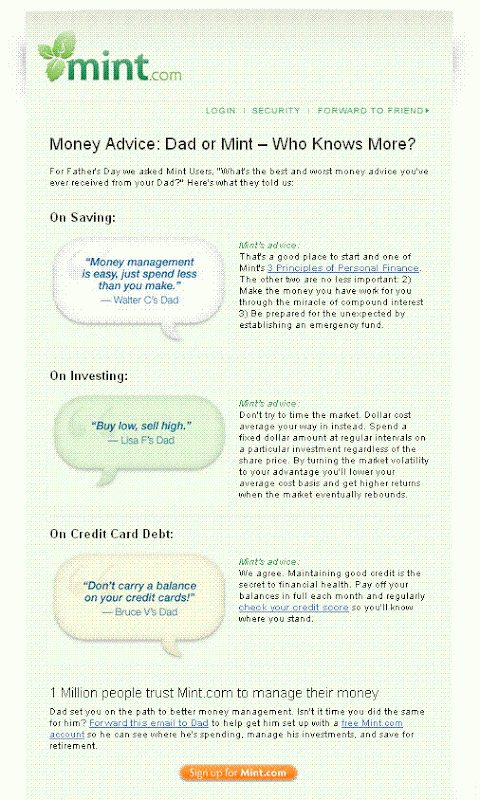
Mint.com's fathers day campaign is an effective combination of Twitter, E-mail and their web-site.

A few weeks ago, the Personal Financial Management ("PFM") web-site, Mint, asked people (via Twitter) to send in the best and worst financial advice they'd ever received from their father (as part of a fathers day theme). You could then watch customers replying on Twitter.

This morning, I received this e-mail from them (I hope Mint will not object to my reproducing it - if they do, please let me know):


I apologise for the fact that it is not very legible.

There is nothing complicated in it. However,
  • it provides an opportunity for contextual links back into parts of the site ("3 principles of personal finance" and "check your credit score")
  • it has a real sense of community ownership - this is the content that we helped create, Mint listened to us and did something about / with what we said, Mint is in tune with our lives (in a very personal family values oriented manner). It does not matter if it is somewhat manufactured in between the Twitter feedback and the e-mail - the people who took part will still recognise their participation, no matter how tenuous.
  • it has a slight but very clever viral element ("forward this e-mail to your dad") to help spread Min't promotion reach across the generational divide. There is a mor generic "forward this to a friend" link at the top, butI think that the more personal "forward this e-mail to your dad" will achieve more resonance given the topic of the e-mail and the fact that they sent it two days before fathers day.
I think that this is an all-round well executed campaign, combining context, community, viral elements and strong clear calls to action.

14 essential tools for strategy analysis [Updated 2023]

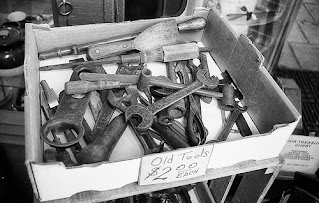
Picture of a box full of old tools

Strategic Analysis is a core step in the Strategic Learning Cycle. Every strategist should have a toolbox of analytical models at his or her disposal.

Having the right tools won't necessarily make you a good mechanic. Nor will having the right strategy analysis tools make you a good business strategist. But they will help a good strategist get the job done more effectively.

Here is my list of 10 essential strategic analysis tools:

1. SWOT

The SWOT is the most basic form of strategic analysis. Simply list the organisation's Strengths, Weaknesses, Opportunities and Threats. (learn more about SWOT)

2. Porter's Value Chain

The value chain is a simple (graphical) method for identifying and describing a firm's main functions and understanding how they contribute to value creation. (learn more about Porter's Value Chain)

3. The Strategy Canvas

The Strategy Canvas was popularised in the book "Blue Ocean Strategy" by W. Chan Kim and Renee Mauborgne. You can use it to understand how a firm differentiates itself from its competitors and other alternatives. (learn more about the Strategy Canvas)

4. The Business Model Canvas

Alexander Osterwalder and Yves Pigneur introduced The Business Model Canvas in the book "Business Model Generation". It is a very effective way of describing the key components of a business model. You can use it as the starting point for strategic analysis as well as for exploring alternative business models. (learn more about the Business Model Canvas)

5. PESTEL

The PESTEL is a macro-scanning framework which is useful for ensuring that you consider a broad range of possible sources of opportunities and threats. The letters represent the Political, Economic, Social (or Socio-economic), Technological, Environmental and Legal opportunities and threats in the firm's environment. (learn more about PESTEL)

6. McKinsey 7S

The McKinsey 7S is useful for ensuring that you consider all aspects of the organisation when identifying its strengths and weaknesses. The 7 Ses stand for: Structure, Systems, Style, Staff, Skills, Strategy and Shared Values. (learn more about McKinsey 7S)

7. Porter's 5 Forces

Porter's 5 Forces model is another framework for identifying threats and opportunities within the firm's environment. It considers the bargaining position of suppliers and customers (including distributors), the threat of new entrants and substitutes, as well as competitive factors within the industry itself. (learn more about Porter's 5 Forces)

8. Pareto Analysis

A Pareto Analysis is based on the maxim that 20% of the products, services, customers or distribution deliver 80% of the profits. A Pareto chart is a useful visualisation for showing this. However, its accuracy depends on the reliability of your cost allocation system. (learn more about Pareto Analysis)

9. BCG Matrix

You can apply the BCG Matrix to any business with more than one product or service line, or more than one customer segment. Plot the market share against the market growth rate for each product, service or customer segment. Then consider strategic options based on their relative position on the chart. (learn more about BCG Matrix)

10. Scenario Analysis

The future is inherently uncertain. Fortunately, good business strategy only requires you to be able to anticipate the future. You don't need to be able to predict it. Scenario Analysis is a tool to help you to anticipate multiple different futures. This allows you to construct your strategy around the premise that you can't be sure which, if indeed any, of them will come to pass. (learn more about Scenario Analysis)

11. Value Proposition Canvas

The Value Proposition Canvas helps to understand what a particular customer segment and how the business satisfies it (the value proposition). For each segment, it allows you to match the customer segments Jobs to be Done, pains and gains. These are then matched against the organisations products and services, gain creators and pain relievers. Pains, gains, pain relievers and gain creators help to move the perspective from the what to the why of an organisations value proposition. This supports better strategic analysis, as well as more strategically aligned marketing.

Given that the customer segments and the value proposition both appear on the Business Model Canvas, the Business Model Canvas and Value Proposition Canvas make very complementary companions. (learn more about the Value Proposition Canvas)

12. Lean Canvas

The Lean Canvas is a version of the Business Model Canvas which is favoured by some people for use in the early stages of conceptualising a new startup. 6 of the 9 categories are identical to those on the Business Model Canvas. However, whereas the Business Model Canvas includes Key Partners, Key Activities, and Key Resources, the Lean Canvas replace these with Problem, Solution and Key Metrics. The similarities between the two make it easy to progress from one to the other as your thinking evolves. (learn more about the Lean Canvas)

13. The Ansoff Matrix

The Ansoff Matrix is a strategic planning tool that helps businesses determine their growth strategy by exploring four key areas: Market Penetration (selling existing products to existing markets), Product Development (introducing new products to existing markets), Market Development (expanding into new markets with existing products), and Diversification (offering new products to new markets). This framework assists in evaluating the risks associated with each strategy, making it a valuable tool for businesses looking to expand or consolidate their market position. (learn more about the Ansoff Matrix)

14. The Balanced Scorecard

The Balanced Scorecard is a strategic tool used for performance management. It translates an organization's mission and vision into tangible objectives and measures across four perspectives: Financial, Customer, Internal Business Processes, and Learning & Growth. By balancing financial measures with those from these additional perspectives, it provides a more comprehensive view of business performance. This approach helps organizations monitor and manage their strategies effectively, ensuring that short-term achievements are aligned with long-term goals. (learn more about The Balanced Scorecard)

You can work with all of these strategic tools online in the StratNavApp.com online application. It's free. And if you are working in a team, you can collaborate with your team members in building your strategic models. Click here to get started.

See also:

6 common strategy problems

In my experience, the most common problems with strategy are:
  1. strategy is not differentiated and specific
  2. strategy is not known and understood
  3. strategy is not actionable
  4. strategy is not linked to departmental, team and individual objectives
  5. strategy is not linked to structure, resource allocation and reward
  6. feedback/management reporting is tactical, not strategic
I'll be posting ways you can overcome these common problems in future posts, so stay tuned / subscribe.

And please feel free to add your own problems and comments below.

Resource allocation: in series or in parallel?

I remember being taught in undergrad finance that the enterprise "can always find enough resource to pursue all opportunities whose return exceeds the risk adjusted cost of capital" (or words to that effect).   A fine theory. But every organisation I've ever worked in always seemed to be short of resources somewhere.

So, scarce resources need to be allocated.

Should you fully resource you highest priority project, then the next, then the next (i.e. in series)? Or should you spread your resource amongst all of the projects (i.e. in parallel)?

This can be visualised as shown below.   In the top half of the diagram we see resources allocated in series - only once Priority 1 has all of the resources it needs, do resources overflow into priority 2.   In this case, priority 4 gets nothing.   In the bottom half of the diagram we see resources allocated in parallel based on the weighting, or relative importance of each of the projects.   (In practice, of course, the buckets would also be of different sizes.)
Most organisations I have encountered have a tendency to resource projects in parralel.   Everyone gets a little resource to appease their demands.   It's a political thing as much as anything else.

But there are three good reasons why it's better to allocate resources to projects in series:
  1. From a practical perspective, it makes sense to allocate resources in series.   It's better to have one project properly resourced and with a chance of success, than it is to have two projects inadequately resourced and with less chance of success.
  2. In a pure financial sense, it also makes more sense to resource projects in series.   Consider these respective NPV calculations (discounted at 15%) where project A and project B both cost £200 and have a payoff of £300.
  3. In seriesNPVYear 1Year 2Year 3Year 4Year 5
    Project A34.68-100-10030000
    Project B26.2300-100-100300
    TOTAL60.91

    In parallelNPVYear 1Year 2Year 3Year 4Year 5
    Project A6.40-50-50-50-50300
    Project B6.40-50-50-50-50300
    TOTAL12.80

    The NPV from funding the projects in series is clearly higher.   Not to mention the additional option value of being able to decide not to start Project B at all at the later date.

  4. It's better for morale - when the first prject finishes, it will give people a morale boost which will carry forward to the later project.

That's not to say you'll never run projects in paralel, just that you should apply all of the resources project A can usefully use before you look at what is available for project B.

For example, not all resources are created equal, and those not suitable to project A might be usefully applied to project B before project A completes. (Consider for example a Marketing intensive project A with few IT implications and an IT intensive project B with few marketing implications.)

So, in practice, whilst there will always be some parallelism in projects, serial resource allocation should be you starting point.