StratNavApp.com banner ad
Showing posts sorted by relevance for query insight. Sort by date Show all posts

Analyse the business and its environment

The world is full of strategy analysis tools, models and frameworks, many of which  are very useful for getting to grips with  the strategic challenges the organisation faces. See 7 essential strategy analysis tools for examples of some of the most popular and useful ones.

However, it is important to remember that all of these models are a means to an end, and not an end in themselves. The 'end' is to generate strategic insight which is useful in generating successful strategy. The strategy analysis frameworks and models may help you to do this, but strategic insights generated without the aid of such frameworks and models can be just as good as those generated with them.

Analysis generally requires data as an input. In strategy, data usually arrives from one of four sources:

  1. data which is generated within your business, such as operational performance data.
  2. data which is generated in the interaction of your business with the outside world, such as from customer or supplier transactions.
  3. data which is generated by primary research, such as customer surveys and focus groups you conduct.
  4. data originating from secondary research, such as industry wide reports.

Whatever the source of the data, the basic process of analysis is the same.

  1. First the data is studied to see if there are any trends: for example 10 daily sales volumes, each higher than the preceding one, shows an increasing trend in sales data
  2. Then the trends are studied to see if they yield any patterns: for example, sales always increase when the weather gets warmer.
  3. Then we attempt to deduce the structures supporting those patterns: customers buy more ice-cream when it is warmer.
  4. And finally we attempt to derive theories explaining what we see: customer buy ice-cream when they are hot because it cools them down.

It is those theories that drive insight. (For example, if we can sell both ice-cream and hot chocolate, our stores will be busy whether the weather is hot or cold. Or, ice-creams compete with soft drinks, not just with other ice-creams.)

As humans we are conditioned to this process and do it so naturally that we don't always notice we're doing it. Unfortunately, we are also fallible and can jump to conclusions without properly considering all of the data. The 'scientific method' is useful in this context. By actively seeking out to disprove our theories, we increase our confidence that the ones we can't disprove may actually be correct.

Analysis is an art as much as it is a science. Some people seem to have a knack for looking at data in different ways which more effectively unlock its secrets.

There are also people who think intuition trumps analysis. They argue that analysis is cold and clinical and doesn't always take into account the whole picture and the subtle clues. I am less convinced. I think that intuition is a form of analysis - its just analysis of the experience data that resides in our brains rather than coded on spreadsheets and in databases.

Big data is having a profound effect on the art of strategic analysis. With more and more data about wider and wider ranges and types of human behaviours increasingly available in computer systems, our ability to derive strategic insight from coded data is better than ever before. See, for example, More data usually beats better algorithms. Of course, the availability of this data increases rather than reduces the burden of analysing it for insight.

Strategic Inception

Most of the best strategies I've encountered hinge on a single strategic insight.

Or, perhaps, a very small number of them.

Peter Compo, author of "The Emergent Approach to Strategy" calls this The Bottleneck. Richard Rumelt, author of "Good Strategy, Bad Strategy" calls it The Crux. Military historians talk about Napoleon's Glance.

Even better is when that single strategic insight is so compelling it one cannot fail to act on it. When it is so elegantly simple that, once seen, it cannot be unseen.

In one client I worked with, it was the realisation that customers who exhibited a certain behaviour were over 4 times more likely to purchase their product than those that did not. In another, it was understanding how their sales teams actually spent their time, given that they lacked the data and support which would enable them to act more effectively. (Apologies that confidentiality requires me to be a little vague about the details! In both cases, of course, the context is vital.)

Leonardo DiCaprio in the firm Inception
Leonardo DiCaprio in Inception
In the film "Inception", the character played by Leonardo DiCaprio says "Once and ideas has taken hold of the brain, it's almost impossible to eradicate."

In that film, the protagonists have access to fantastical technology for embedding ideas in people's brains in a process they call Inception.

Sadly (or perhaps gladly, when you see how the film turns out), we don't have access to that.

And so our work is:

  1. to keep delving until we uncover that single strategic insight that compels action, leaving no stone unturned until you have the Eureka! moment,
  2. to embed it throughout the organisation through regular repetition of an elegantly simple explanation of that insight,
  3. without becoming so beholden to it, that we fail to notice and adjust when the circumstances around us change.

We can, of course, settle for less. There are plenty of strategies which are "good enough". But if we want truly great strategies, then that is the task we must set ourselves.

Honest people may differ - listening for strategic insight

I did my MBA in South Africa shortly after the transition from apartheid to full democracy in 1994.

It was a time of unparalleled transformation - political, economic and social - which has served as a model for other countries ever since. It produced world leaders of the gravitas of Nelson Mandela and Bishop Desmond Tutu, and ground-breaking civic processes like the Truth and Reconciliation Commission. And, in many senses, that transformation continues to this day.

And it was by no means a simple nor an easy process!

The lecturer on our Politics and Business model had his work cut out for him. Trying to help us students make sense of the implications of a transformation that was still raw and in progress. Where opinions had been tempered by years of bitter struggle. And where the world in which we lived was suddenly very different to anything any of us had ever experienced before.

I remembered he peppered his presentation with the phrase "Honest men may differ".

(These days, one might prefer "Honest people may differ". But all those years ago, and given everything else that was going on at the time, we might perhaps forgive this lapse.)

It was a recognition that, whilst he could tell us what he though, he recognised that others might disagree. More than that, it was a recognition that those who did disagree weren't necessarily either wrong or disingenuous in their views.

And for me, it opened up the possibility that behind the differing opinions of honest people there might lie some deeper truth which bound those contradictory understandings together.

That's an understanding I've taken into my strategy consulting practice.

Often, when an organisation invites me to help them, it is because they've reached some sort of impasse. Where the executive decision makers can't agree on a way forward.

Part of my role is to listen and understand without taking sides. To ask questions. To get behind their assumptions and to find the hidden insights which lead everyone to a greater understanding of the strategic challenges and opportunities the organisation faces.

I remember working with a mid-sized asset manager. There was one faction within the leadership team who believed it was absolutely essential for the organisation to scale. And to do so very significantly. By orders of magnitude. They presented evidence that the very largest asset managers were able to produce the highest returns.

But a second faction believed that their advantage lay in remaining smaller. This would allow them to pick and choose the best opportunities without having to play "the whole market" as the larger plays had, by necessity, to do.

How could both hold such diametrically opposite views? After all, these were seasoned investment professionals! They certainly weren't anybody's fools!

After some digging, we were able to determine that the answer lay in expense ratios. The largest asset managers were not, in fact producing higher absolute returns. But higher economies of scale meant they were able to reduce their expense ratios. This, in turn, drove up their net returns. Similarly, some smaller asset managers were able to produce higher absolute returns, by being more selective in their investments. But they lacked the economies of scale. This meant that their net returns were relatively lower.

This simple insight transformed the conversation. No longer were the two factions diametrically opposed. They now had a common understanding and were able to work together to solve a common challenge.

The specifics of the case are unimportant. But perhaps you've encountered similar situations?

The lesson for me is always to listen to people as if they are right. As soon as you think they are wrong, you start listening with a view to disproving them. But if you listen to them as if they are right - no matter how strongly you disagree with them - then you have a chance of uncovering fresh insight.

And the way to do that is to remember that honest people may differ.

When you encounter differing views, ask each to explain their position to you as if you genuinely don't understand but want to learn. Draw out their logic, the assumptions, and the evidence on which they are based. Keep going until you genuinely understand how, given that evidence and those assumptions, their position is logically correct.

Then examine the evidence and assumptions. Compare it to the evidence and assumptions that lead to the competing conclusion. What's missing? What other conclusions could you draw from the same evidence and assumptions?

Of course, all of this takes time and practice. Often, it needs objectives outsiders without any personal stake in either of the differing opinions being either right or wrong. That's why organisations turn to experienced outsiders.

How to do a PESTEL analysis

Image of PESTEL Analysis
PESTEL Analysis

Contents

What is a PESTEL analysis?

PESTEL analysis is a business strategy framework which is used to identify, categorise and analyse the key external threats and opportunities a firm faces now and into the future. 

The six letters in PESTEL represent the 6 most common categories used: P for Political, E for Economic, S for Social (or Socio-Economic), T for Technological, E for Environmental and L for Legal.

It is often termed a macro-scanning tool. This is because it involves looking a the big-picture long-term changes in the external environment. (The external environment is also sometimes called the macro-environment.)

A PESTEL analysis is a key input to most strategy development and execution processes.

Why should you do a PESTEL analysis?

The PESTEL analysis is an essential strategy analysis tool for any strategist's toolkit.

Together with other tools such as Porter's 5 Forces analysis it encourages firms to consider the external environment in which they operate. This is particularly important for more established, mature firms, which have a tendency toward bureaucracy and become inward-looking.

PESTEL analysis can also provide a more forward-looking perspective by flushing out trends. This can provide advance warning of potential threats and opportunities, giving the firm more time to react. The different possible outcomes from these trends can then also be combined and developed into scenarios.

PESTEL analysis is particularly powerful when used:

What goes in each of the 6 categories on a PESTEL analysis?

Different factors will be more or less important to different businesses or industries. The descriptions below attempt to be as broad and comprehensive as possible so that you can choose what you think is relevant to your situation.

Political

The Political sector includes any government, parastatal and special interest group actions or lobbying in the form of policy, legislation, taxes and duties. It also considers the stability or instability of governments. It is important to understand the political agenda and how it might move for or against certain industries or practices.

This might include:

  • 'positive' moves such as the subsidies offered for alternative green energy production, or
  • 'negative' moves such as increasing taxes on alcohol or tobacco.

Depending on your firm, it may be important to consider both domestic policy as well as international policy, trade policy and pressure groups.

Quick checklist

  • Government policy
  • Legislation
  • Political harmony/conflict and stability/instability
  • Elections and coalitions
  • Foreign trade policy, restrictions and agreements
  • Tax policy
  • Labour policy
  • Forthcoming elections and election cycles
  • Government stability
  • Lobbying activity and protests
  • Defence policy and spending
  • Terrorism, war and other military considerations
  • Environmental policy
  • Funding grants and initiatives
  • Subsidies and tariffs
  • Fiscal policy
  • Freedom of speech and the press
  • Government bureaucracy

(See, for example, Three different regulatory responses and their impact on industry.)

Questions to ask:

  • Is the political environment stable? If not, how might it change?
  • What government policies or political groups could be beneficial or detrimental to the firm's success?

Economic

The Economic sector includes the general economic environment and the effects that this might have on the business and its customers, distributors and suppliers.

In conducting your analysis, it is important to distinguish between

  • long-term trends and structural issues, and
  • seasonal or cyclical issues.

Quick checklist

  • Economic growth (e.g. GDP)
  • Interest rates
  • Exchange rates
  • Inflation
  • Disposable income of consumers and businesses
  • Savings and investment rates/propensity to spend
  • Taxation
  • Wages (both absolute levels and growth rates)
  • Employment/unemployment rates
  • Financial markets
  • Property prices
  • Commodity and raw materials prices
  • Availability of finance/credit
  • Supply and demand factors
  • Cycles and bubbles

These might operate in aggregate or on a sector-specific basis.

Internationally, you might also consider:

  • import/export conditions,
  • foreign exchange conditions, and
  • trade deficits/surpluses.

Questions to ask:

  • How, specifically, do each of the different economic factors impact the firm's business?
  • What factors could cause an improvement or deterioration in each of the different economic factors?

Social

The Social sector considers changes in social preferences and norms. This is sometimes also called the Socio-Economic or Socio-Cultural sector.

Quick checklist

  • Demographics, including
    • Population growth
    • Population age distribution
    • Birth and death rates
  • Family size and dynamics
    • Marriage, divorce and cohabitation
  • Living standards
  • Wealth distribution
  • Ethnic and religious view and norms
  • Health and health consciousness
  • Education standards
  • Career choices and attitudes
  • Work patterns and preferences, including attitudes towards
    • retirement
    • flexibility
  • Customer preferences and buying trends
  • Leisure activities and lifestyles
  • Cultural trends
  • Fashion trends and fads
  • Industrial reviews and consumer confidence
  • Organisational image
  • Attitudes towards the government, business and equality/diversity (race, gender, ability, foreigners/immigrants, minorities, etc.)
  • Crime

Questions to ask:

  • How do our customers' circumstances and attitudes affect their buying habits?
  • How are our customers' and other stakeholders' circumstances and attitudes changing?

Technological

The Technological sector considers the impact of all forms of technological development and innovation.

This could include

  • new ways of producing goods and services
  • new ways of distributing goods and services, and
  • new ways of communicating with and engaging customers, suppliers and distributors.

The development of information technologies, including the internet and associated technologies such as mobile access is obviously a major factor here. This includes both the consumer and business-to-business applications of this. But it also includes improvements in manufacturing processes, materials, energy and transportation.

Quick checklist

  • Research and development capability and pipelines,
  • Producing goods and services
  • Distributing goods and services
  • Communications infrastructure
  • Digital and mobile technologies
  • Automation
  • The Internet of Things (IoT)
  • Emerging technologies
  • Technological lifecycle: including maturity and obsolescence
  • Target market communication
  • Copyright or patent protection for intellectual property ("IP"), and their efficacy
  • Increased training required to use new technologies
  • Potential return on investment from new technologies
  • Technological awareness and proficiency

Questions to ask:

  • What innovations and technological innovations are available or on the horizon?
  • How might they affect the firm?

Environmental

The Environmental sector has become increasingly important in recent years as stakeholders have become more conscious of humankind's impact on the natural environment.

Consider:

  • changes and opportunities throughout the value chain which could impact the environment, including,
  • opportunities to communicate what the organisation is doing about them more effectively, and
  • Corporate Social Responsibility (CSR) where businesses contribute to societal goals either through how they operate and/or through philanthropic activities such as volunteering or charitable donations/activities.

Quick checklist

  • The availability of raw materials
  • Pollution and greenhouse gas emissions
  • Positive business ethics and sustainability
  • Carbon footprint
  • Climate and weather
  • Natural disasters
  • Renewable energy, waste management and recycling
  • Environmental legislation
  • Geographic location and accessibility

Questions to ask:

  • How is the physical environment changing and how will this impact the business?
  • How are attitudes towards the business's impact on the physical environment changing>

Legal

Finally, the Legal sector looks at changes in laws, lawsuits and regulations which affect the business. These can be general changes in the industry, or specific lawsuits or regulatory interventions or sanctions which the business is facing.

Quick checklist

  • Health and safety regulations
  • Equal opportunities laws
  • Advertising standards rules
  • Consumer rights and protections
  • Privacy and data protection laws
  • Product labelling requirements
  • Product safety requirements
  • Safety standards
  • Employment/labour laws
  • Anti-trust and competition laws
  • Copyright, patent, intellectual laws
  • Licenses and permits

Note that there is often a high cross-over between political and legal factors. However, while political policies may create certain advantages and disadvantages, legal factors must be complied with.

Questions to ask:

  • What laws and regulations apply to the business across all of the markets in which it operates and how do they help or hinder the business?
  • How might these laws and regulations change?

What are some variations of PESTEL analysis?

There are several variations of the traditional PESTEL analysis. These include:

  • PESTLE analysis: a simple re-ordering of the last two letters/categories.
  • PESTLIED analysis: includes additional letters/categories for International and Demographic.
  • STEEPLE analysis: includes a third E for Ethical.
  • STEEPLED analysis: like STEEPLE but also including a D for Demographic.
  • SLEPT analysis: a simple re-ordering of the letters/categories, with the Environmental category removed.
  • STEPE analysis: a simple re-ordering of the letters/categories, with the Legal category removed.
  • PEST analysis: a simplification without the last two letters/categories for Environmetal and Legal.
  • STEP analysis: PEST in a different order.
  • LONGPEST / LONGPESTEL: LOcal, National and Global factors plus PEST or PESTEL.

In addition, the L is sometimes taken to mean Labour, rather than Legal.

The existence of all of these variations drives home the fact that it does not really matter which words and letters you use as long as you have a systematic review of the competitive environment.

How to do a PESTEL analysis

There are a number of steps you can take:

  1. Brainstorm: get a cross-section of people together from different areas and functions with the business to brainstorm some initial ideas.
    • Use the suggestions and questions outlined above for each section as input to your brainstorm.
    • Brainstorm not just what is happening or could happen, but also what the positive and/or negative impact on the business could be.
  2. Consult: seek the opinions of experts from outside your business.
    • These could be customers, distributors, suppliers, consultants, academics or any other experts.
  3. Research: gather evidence for each insight in your PESTEL analysis.
    • It is important to not only look for evidence which supports the insight, but also to gather any evidence which might contradict it. Few things in a PESTEL analysis are guaranteed cut and dried.
  4. Evaluate: score each of the items on your PESTEL analysis for:
    • likelihood: if it is not already happening, how likely is it to happen.
    • impact: how big an impact could it have on the business.
    • You can let all members of a team score each insight individually, and then debate until the scores start to converge.
  5. Refine: repeat the process until you have narrowed it down to a manageable number of clearly articulated and insightful points in each of the 6 categories.

How to do PESTEL analysis well

PESTEL analysis, like SWOT analysis is frequently criticised. Usually, this is usually on the basis of an analysis that has been done poorly. For example, PESTEL analysis often degenerates into long lists of 'things' without context, relevance or evidence. Don't fall into that trap. If you do, most of the time you spend doing PESTEL analysis will be wasted.

As you work through each quadrant, it is important to identify and document:

  • What is happening or could happen?
  • What is or could be the impact on your firm/division/department? (That is, be sure to answer the proverbial "So what?" question.)
  • What evidence you have to support this assessment?

A good way to express something on a PESTEL would be along the lines of:

X could/will/is caus(e/ing)/lead(ing) to Y (which leads to Z)
with evidence provided in supporting paragraphs and charts. 

Depending on how thorough you are being, you could also try to quantify the likelihood and impact of various levels of change happening, and the time frames over which they might happen.

Finally, you should consider the environmental signals you intend to monitor to stay abreast of any changes, or the actions you might take to influence the outcomes (such as joining an industry or policy group and or lobbying for changes).

Avoid the temptation to make decisions based on individual insights from your PESTEL analysis. Instead, base decisions on the balance of evidence across the whole of the PESTEL analysis and within the context of all of your other strategic analysis and priorities.

Where can I get a PESTEL analysis template?

You can easily create a simple PESTEL analysis template in common programmes like Microsoft Word, PowerPoint or Excel using a simple table structure.

Alternative, you can build a PESTEL analysis, alone or with a team, using a tool like StratNavApp.com. StratNavApp.com is the online collaborative tool for business strategy development and execution.

Using a purpose-built tool like StratNavApp.com has a number of advantages. For example, StratNavApp.com will:

  • Keep track of which users made which changes to your PESTEL analysis, and when.
  • Help you collect and link evidence in support of each insight on your PESTEL analysis.
  • Link insights from your PESTEL analysis to other appropriate areas of your business strategy.
  • Free accounts are available, it works on all devices and no other software (other than a browser) is required.

Examples of PESTEL Analysis

Here are some examples of PESTEL Analyses.

How often should you do a PESTEL Analysis?

It depends on how quickly your industry and competitive environment changes. These days, the pace of change for most businesses is quick rapid. So you should probably review your PESTEL analysis at least every 6 months.

A better approach, however, is to monitor the environment on a continual basis. Nominate specific people in your business to keep an eye on different sectors in your PESTEL analysis. Choose people who have natural if not professional interest in that subject. Ensure those people are reading the relevant journals, and talking to your suppliers, distributors, customers and other stakeholders about their allocated sector on an ongoing basis. Charge them to keep the analysis up to date and alert the rest of your team if there are any material changes in their sector.

A tool like StratNavApp.com will make this easier to do.

See also:

What is strategy development and execution?

People argue about which is more important: strategy or execution. This is a false dichotomy. Both are important. In fact, each is worthless without the other.

In strategy, development and execution are opposite sides of the same coin.

Defining strategy development and strategy execution

Strategy development is the process of deciding and agreeing what an organisation will do, when, for whom, how, and why.

Strategy execution is the process of allocating resources, changing and aligning the organisation to deliver that strategy.

The problem with strategy development without execution

The problem with strategy development without execution is fairly obvious. Without execution, your strategy will never be more than an aspiration. Nothing will change.

Unfortunately, this is exactly what happens with many strategies. The leadership develops a new strategy and announces it to the rest of the organisation and then... not much happens.

A popular remedy for this problem is to try and involve more people in developing the strategy in the first place. Whilst this can help, it is usually not enough. Sometimes, it can make matters worse. People, be they staff, customers, suppliers or others, can be great sources of insight. But someone still has to process that insight. Strategy is about making choices and trade-offs. It should not be an attempt to give everyone what they want.

Instead, strategy execution requires rigour and discipline:

  • Communicate clearly and unequivocally. It should include not only what the strategy is, but why it is that. It is important to distinguish between when you are asking people for their input, and when you are communicating a new strategy to them.
  • Establish accountabilities, track and report against carefully thought out milestones, scorecards and KPIs.
  • Allocate resources. More often than not, this means re-allocating from what is now relatively less important to what is now relatively more important. Change structures and reporting lines accordingly. Terminate or redirect programmes which no longer fit.

All of this can be very uncomfortable. Strategy involves change. Many people resist change - especially where it challenges their existing power base.

The problem with strategy execution without development

The problem with strategy execution without development is more subtle.

If you haven't developed a strategy, what will you execute? Unfortunately, this does not seem to stop many organisations. The result is 'busy work'. People pursue their pet projects just because they can. Or they deploy resources to do things just because they worry that those resources will be taken away from them if they're not seen to use them.

Even more subtle is the problem of strategies which are not executable.

Some so-called strategies are little more than grand slogans, woolly ambitions or jargon-packed corporate double-speak.

When asked to execute them, staff don't know what they're actually supposed to do. What should change?

And so they play it safe. They carry on doing what they were doing before. Or they use the opportunity to pursue their pet projects.

If they are smart they will rebadge their existing work or pet projects as being central to the execution of the strategy. And because no-one can say for sure what the strategy dictates instead, it can be hard to contradict them.

How can you overcome these problems?

To overcome these problems:

  • Make sure that your strategy articulates clear choices. It is as important to say what the strategy is not as to say what it is. You haven't really done strategy until you've decided not to do something.

  • Avoid unqualified comparative statements. As a general rule, avoid words like "best", "leading" and "world-class".

    For example, a company might say it wants to be "the worlds best widget manufacturer". That is a fine ambition. But what does it mean? What, specifically, constitutes best? How will this be achieved?

  • Describe as vividly as you can how the organisation will be different after executing the strategy than it was before.

    Focus on tangibles - changes to processes, resources, products and services - rather than intangibles. Focus on what you will do differently, rather than on what you will become by doing it. (What you will become is also important. But you won't become it unless you do something. So focus on that.)

    For example, a company might say its strategy is "to become the most trusted widget manufacturer". Again, that is a fine ambition. But what will the company do to achieve that?

  • Avoid sitting on the fence or delegating your strategy.

    For example, a company might say its strategy is to be customer-centric or to listen to its customers and what they need. Those are both noble ambitions, but they are not strategy. Strategy describes the choices you make after having listened to your customers, understood their needs, and decided what you will and won't do about them.

    The same goes for equivalent statements like "putting staff at the heart of our business".

  • Use tried and tested tools like StratNavApp.com for developing and executing your strategy.

    StratNavApp.com contains all the tools you will need. They're integrated, collaborative, online and available everywhere all the time. So it will help you do the heavy lifting of incorporating inputs, processing them, generating strategy output, allocating accountabilities and responsibilities and tracking progress.

    You can, of course, try and do all of this on your own. But why would you, since the tools exist. It'd be like hammering in a nail with your fist because you didn't want to use a hammer.

Strategy development and execution are equally important parts of a holistic process. It is as important to develop strategies that are executable as it is to ensure that what is executed is the strategy.

The 4 Worst Kinds of Strategies

I encounter many strategies in my day to day work. Some of them are brilliant, of course. Others, less so. The worst of them tend to fall into four categories:

1. Waiting for the environment to improve.

It is easy to blame environmental factors for your lack of success. And it is a short jump from there to concluding that if you just wait for the environment to improve then everything will be OK. But the truth is, the environment (regulations, economy, etc.) are more likely to continue to become more complicated and difficult than they are to suddenly get better.

Your strategy should be robust across a range of environmental conditions. Preferably, your strategy should even shape environment conditions. But your strategy should not be to wait passively. Strategy is an active process. And even if the environment does improve, all ships rise with a rising tide. So your competitors are likely to benefit just as much as you are. Even more so if they have adopted a more proactive strategy.

See also:

2. Hoping your competitors will falter.

Every business should be in tune with its competitors' strengths and weaknesses. And ready to exploit any weaknesses it finds. But simply waiting for your competitors to make a mistake is too passive. As noted above, strategy needs to be an active process, not a passive process.

Hoping your competitors will falter lays yourself open to three risks.

  1. What if they don't falter? What if they actually have competent staff who are able to respond to the challenges you thought you had spotted but they would miss.
  2. Your competitors are not sitting idly by. They are hungrily eyeing your lunch. While you are waiting to see if any crumbs fall from their table, they may be planning a direct assault on your business.
  3. How do you know you're not going to make a mistake before they do? Can you be that convinced of your superior insight and ability to execute? If you genuinely had that superior insight, how come your competitors are still in business?

No, you can't sit by and wait for someone else to make a mistake. You must go out there and grab the market share and competitive position you can for yourself.

See also:

3. Listening to your customers. 

Don't get me wrong:- listening to your customers is essential. Every business should do it. And you should take what you learn from your customers into account when formulating your strategy. But listening to your customers is not a strategy in itself. Customers want to be led. They are drawn to businesses with products and services that solve their problems and exceed their expectations. They are looking for solutions and answers, not problems and questions.

Yes, customers may be willing to participate in crowd-sourcing from time to time. But they don't want to be your R&D department. They are looking for someone else - you - to apply the creativity and engineering. Oftentimes, customers don't even know what they want until they see it. If your strategy is simply to listen to your customers and respond to them, you will always be behind their expectations. And sooner or later, some competitor will come out with the product or service that your customers never knew they wanted. And that is where they will go.

See also:

4. Strategy based on hubris

Some strategies are based on a strongly held but ultimately mistaken view of an organisations strengths and capabilities. It is good to proud of the organisation you work for. But, as they say, pride comes before a fall. And pride without evidence makes this all the more likely.

Any time you see a strategy which claims a a strength without substantiating it should be a warning sign.

Examples I've seen include:

  • claiming to have a market leading brand without any tangible evidence of brand recognition or attribution either in absolute terms or relative to the competition.
  • claiming "it's all about our people" without providing any evidence of what those people are able to deliver or how it creates value for customers compared to the competition.

In fact, any time you come across someone who just knows they are the best but can't explain or evidence why, you're on shaky strategic ground. And even if that belief turns out to be true, that lack of understanding will make it difficult to build a meaningful strategy around it.

Richard Rumelt wrote:

"Bad strategy flourishes because it floats above analysis, logic, and choice, held aloft by the hot hope that one can avoid dealing with these tricky fundamentals and the difficulties of mastering them."

 - Richard Rumelt, author of Good Strategy / Bad Strategy

Does your strategy suffer from any of these shortcomings? Perhaps it's time you called for some independent assistance.

Everybody Lies: The evolution of market research

"Everybody Lies" by Seth Stephens-Davidowitz, is one of the most fascinating books I have read in a long while.

Stephens-Davidowitz documents and evidences in page-turning style a view I have held for some years now:

  1. We can now observe how people actually behave, especially when they don't think anyone is looking, in ways which were previously not possible.
  2. What we observe is often very different from:
    1. what they say they do or will do, and
    2. how they behave when they think someone is looking.

I would guess that Stephens-Davidowitz borrowed the title of his book, whether knowingly or not, from the byline of the TV series "House M.D.". The lead character says "It's a basic truth of the human condition that everybody lies. The only variable is about what."

Reading the book has given me pause to reflect on the evolution of market research. My personal experience suggests at least 3 waves of development.

Market Research 1.0

The first wave of market research consists of asking people for the views, preferences, intentions, wants and needs, etc. This can be:

  • quantitative, for example, in the form of a survey, or
  • qualitative, for example, in the form of a focus group, etc.

The obvious problem with this is, of course, that people have many reasons to lie, and few reasons not to. Reasons to lie can be very simple. For example, we may want to appear intelligent, or virtuous, or be liked or admired by the questioner.

Often, people won't even be aware that they are lying. As humans, we are excellent post-rationalisers. Cognitive Dissonance Theory suggests that when faced with a question we can't or don't want to answer, our brains simply fill in the blanks. We make up a story. We may not even be consciously aware of it. (Note: I'm using the word 'lie' here throughout, even when subjects are doing it unintentionally and unknowingly.)

Another problem is that people find it difficult to answer questions about subjects outside of their existing frames of reference. For this reason, market research 1.0 is even less helpful when developing novel ideas. As Henry Ford apocryphally said: "If I had asked people what they wanted, they would have said a faster horse."

Market Research 2.0

Market Research 2.0 attempts to build on Market Research 1.0 by showing customers examples of what future products or services might look like. Often, more than one version is shown. Subjects may be asked to interact with them, compare them and indicate their preferences.

This can go a long way to alleviate subjects inability to imagine a different future. And if all options are attractive and presented positively, this will also reduce some of their incentive to lie.

Market Research 2.0 requires more work than Market Research 1.0. It usually means that you first need to develop some ideas to test. If you're innovative in the development of those ideas, that helps. But the innovation is likely coming from the development of the ideas, rather than from the market research.

However, a number of examples illustrate the difficulties still inherent in the approach:

  1. Subjects reportedly overwhelmingly rejected the idea of ever withdrawing cash from a hole in the wall, as opposed to from a bank teller. But today, 94% of UK adults use cash machines.
  2. In market research, 68% of US customers said they liked the taste of New Coke. But 6 months after launch it was removed from the shelves, and the old formula relaunched. (Reference)
  3. Research conducted between the announcement and launch of the iPhone found high demand in emerging economies like Mexico and India, but not in developed countries. It concluded that: “There is no real need for a convergent product in the US, Germany and Japan”. (Reference)

As I write, I can think of at least two factors which might contribute to this problem. I am sure there are countless more:

  1. The Hawthorne Effect (also known as the Observer Effect). This is named after experiments conducted from 1924-32 in which it was shown that subjects' behaviour is altered by virtue of the fact that they know they are being observed.
  2. Research subjects typically have no 'skin in the game'. For example, it is a lot easier to say you'd be happy to pay, say, £100 for an item than it is to forego the other enjoyments you'd have to give up in order to do so. This is probably exacerbated where they are positively incentivised to take part in the study.

Market Research 3.0

Market Research 3.0 observes:

  • how real prospects and customers behave with and use products and services,
  • in the normal course of their lives, and
  • when they don't think they are being watched.

As technology evolves it is increasingly possible to track:

  • how customers move through a store,
  • what items they buy, and 
  • how they engage with and dispose of those products.

This involves developing and launching a product before market testing it. But with increasing software content in products and services (think the Internet of Things) and advances in technologies such as 3D printing, it is become ever cheaper to develop and pilot smaller batches of products or to mass-customise products and services.

Sample Application

I use these techniques to great effect in the development of StratNavApp.com in three ways. It is important to stress, however, that all three techniques are based on statistical analysis. They don't involve anyone ever looking at users' data or strategies. And they don't attributing the results to any specific individuals or companies.

Here are some common ways we measure and

  • Website analytics: using even a simple (and free) tool like Google Analytics, it is possible to understand
    • how users find the service,
    • which parts of it they visit most frequently and in what order,
    • how long they engage, and 
    • from where they leave.
Using this insight, we can prioritise our development efforts to those areas and features users find most valuable. So, for example, we know that our SWOT analysis tool has been 24% more popular than our Strategy Canvas tool and 33% more popular than our Business Model Canvas tool (confirming our views on the continuing popularity of the SWOT).
  • AB Testing: almost all new features are first introduced to a randomly selected subset of users (the "A" group"). At the same time, the remaining users (the "B" group) continue to see the site unaltered. We can then measure whether the A group engages more positively (against our own defined Critical Success Factors) than the B group or not. If they do, then the feature is released to the remaining users. And if they do not, then the new feature is rolled back or adjusted and retested. Either way, the results are analysed to enhance our picture of how users use the service, and how we can further improve it.

    By way of a very simple example, StratNavApp.com's byline "Collaborative strategy development and execution" was the winner from among a number of AB Tested alternatives considered.

  • Content Analysis: StratNavApp.com provides a unique insight into how users develop and execute strategies. By way of a very simple example, we know that the word 'Market' is used almost twice as frequently as the word 'Customer' when describing strategic insights. We may not know why that is. And we may not know if it is a good thing or not. But we can certainly use it to enhance our product. We can analyse word counts, numbers and lengths, etc. of all elements used in StratNavApp.com with a view to optimising users' experiences of the tool.

Privacy and Ethics

This is not intended to be a post on privacy and ethics. However, it goes without saying that privacy and ethics have always been a key consideration in market research. And it is right that there is ongoing debate and development of this subject as it evolves.

Conclusion

We've always known that market research is both invaluable and limited. As new technologies evolve, we are able to increase the value it adds whilst simultaneously reducing its limitations. Those organisations that explore and utilise these new approaches will be at a distinct advantage over those that do not.

Addendum

Watch Seth Stephens-Davidowitz talking about his book at the RSA:


Other resources:

Build your wings on the ground

I recently saw this quote:

“We have to continually be jumping off cliffs and developing our wings on the way down.”

- Kurt Vonnegut

This is one of a category of quotes about failure, risk taking and entrepreneurship which I think are misleading and dangerous.

I wonder if they are propagated by venture capitalists?

You see, if you're a venture capitalist, then this is sensible advice to give. If you invest in 100 jumpers, you don't care if the first 99 plunge to their deaths, as long as the 100th jumper succeeds and you can make all your losses back.

But if you're the first jumper in the queue, it's terrible advice. When you're dead, it doesn't matter how many others succeeded or failed after you.

In this example, we would say that the venture capitalist is involved, but the entrepreneur is committed; the venture capitalist has skin in the game, but the entrepreneur is betting the farm.

Quotes like this are meant to encourage entrepreneurs to take bigger risks. "Entrepreneurship is about taking risks", it tells us, leaving out the all important "Entrepreneurship is about mitigating risks".

Now, I appreciate that the quote is not mean to be taken literally. It's not advocating that people actually jump off cliffs. (And I am not suggesting that venture capitalists don't actually care about people plunging to their deaths.)

But it is proposing that people take extreme and, I will argue, unnecessary risks in order to make progress.

And even if you're not plunging to your death off a cliff, you may be losing your home, sacrificing your marriage, friendships and other family relationships, and ultimately your happiness. So I think it is worth thinking about this a little more deeply.

The person who posted this quote told me that:

  • taking that such risks would 'focus the mind', 
  • we need to take risks to learn, and
  • the advice is not meant to be taken literally.

Fear focuses the mind

It is undoubtedly true that risk and fear focuses the mind. I am sure that finding yourself plunging off the edge of a cliff would get your attention!

But is it the best way to focus the mind?

I doubt it. Fear invokes our lizard brain. This controls our fight, flight or freeze reflex. It is great in circumstances of imminent peril. But, at the same time, our higher order decision-making is impaired. This is not great for problem solving or learning.

Instead, in his book "Flow", Mihaly Csikszentmihalyi describes "a state of concentration so focused that it amounts to complete absorption in an activity".

According to the author, Flow is achieved where we have:

  • clear objectives,
  • a good balance between the requirements of the activity and our own abilities,
  • a clear feedback loop.

Jumping off a cliff and developing wings on the way down, ticks only one of these boxes. The objective is clear: build wings so you don't die. But our ability to build wings in a matter of seconds is probably not up to the job.

And feedback really only works we we have multiple iterations. That is, where we can try once, get some feedback and then try again. It does really work well when we can only afford to try something once. That is when we're betting the farm.

We need to take risks to learn

I've debunked this argument before, in It's time we stopped idolising failure in innovation.

Sure, some risk is inevitable. But it's like the carbon dioxide emitted by internal combustion engines - an unpleasant by product which we take great pains to minimise.

We are fortunate that the Wright Brothers did not receive and take this advice. They built their wings on the ground. And they tested them as safely as they could. They conducted extensive research before, during and between numerous tests. They did everything they reasonable could to minimise their risks.

Had they simply flung  themselves off the nearest cliff we might have had to wait many more years before someone else achieved powered flight in a heavier-than-air craft!

It's not meant to be taken literally

This was the final defence of the quote which was offered to me.

But advice that is only good to the extent that you don't actually take it is bad advice.

If the opening quote is not advocating that we take extreme and potentially catastrophic risks, then what is it advocating? What good point is it making that a different example, without all the potential for misinterpretation of this one, could not have made more effectively.

I suspect that quote was originally made, and has subsequently circulated, because it is attention getting. Much like a tabloid headline. It's a cheap trick to draw us in. But like a sugary snack, it offers no nourishment.

We have millions of ways of mitigating risks. We have parachutes and wind-tunnels, we have startup incubators, we have countless ways of researching and testing ideas, and we can break big risky ideas down into smaller more manageable and testable chunks.

We should use them. We should not simply throw caution to the wind and leap off a cliff.

In short, we need a better-quality discourse about entrepreneurship, risk-taking, innovation and learning.

Risk is relative

If you're a wealthy billionaire, then betting a few million here and there is relatively low risk. After all, Elon Musk could lose $250bn overnight, and still be wealthier than most people on the planet.

The small entrepreneur who takes a second mortgage on their home to buy a neighbourhood restaurant is taking more risk than Elon Musk was when he tried to buy Twitter for $41.39bn. Their downside is greater and their ability to recover from failure is lower.

So perhaps Elon Musk can afford to be a little cavalier. The rest of us should be suspicious of those who advise us to act in the same manner.

My advice

My advice: "Build your wings on the ground, but start working right away."

Perhaps it won't sell as many tabloid newspapers. But it might just help you achieve more success in life and business.

Business strategy development and execution is about finding a balance between thought and action. It's about thinking and acting strategically.

It's about seizing the opportunities, whilst avoiding the threats. It's about being realistic about our strengths and weaknesses as they impact our ability to do so. It's about optimising the chances of success whilst mitigating the risks of  failure.

It doesn't always lend itself to pithy little sayings. It requires a little work. But its better than throwing yourself off a cliff.

Footnotes

  1. According to Wikipedia, Kurt Vonnegut was "an American writer known for his satirical and darkly humorous novels". There is nothing about his profile to suggest that he had any experience of or insight into business or entrepreneurship, or that the quote was meant to be taken in that context.
  2. According to quote investigator,
    1. the  quote actually originated from Ray Bradbury in 1986 in a keynote address about following your heart. He used the quote again in an interview in 1990 in the context of love affairs and friendship. According to Wikipedia, Bradbury was also a fiction author and screen writer. Again, there is no suggestion of any experience of or insight into business or entrepreneurship.
    2. the quote was adopted by airline executive Franco Mancassola, in an interview in 1998. He said: "I tell managers: 'I have absolute faith in your abilities, and should you fail, I'll have absolute faith in your replacement. I live by the rule, 'jump out of the plan and build your wings on the way'." It seems Mancassola believed that people were expendable in the manner in which I cautioned against above. According to Wikipedia and Jet Back In Time, the airline he founded survived for only 3 and a half years before ceasing operations due to financial problems.

Forced compliance is not the same as strategic alignment

Good strategy can be divisive. Any change results in winners and losers. Some people have a strong preference for the status quo above almost any change.  In fact, it is said that if no-one objects to your strategy, it is probably not a very good strategy.

A common response from strong leaders is to demand compliance. "FIFO!" they declare ("Fit in or F off"). Those who oppose are chastised, marginalised and even dismissed.

Strategy almost always requires people to work together to achieve it - so-called strategic alignment. But strategic alignment cannot be demanded, it must be earned. If those opposed to a strategy don't feel free to voice their concerns, then they will simply go underground, proclaiming their support while subtly working to undermine the strategy.

There is, of course, a middle ground. And it is much better than having a strategy so bland that no-one disagrees, or a culture so based on fear that no-one dares to.

The fact is that every strategy has risks and downsides - the bolder the strategy the greater the risks and downsides invariably are. To pretend otherwise is folly. And to dismiss discussion of them denies you the opportunity to better understand and mitigate them.

A good strategist pursues their strategy relentlessly whilst also remaining acutely aware of and actively mitigating the risks.

The solution is to reframe negative criticism into constructive problem solving. Ask questions like:

  1. "Given your concerns about what could happen if we pursue this strategy, what steps might we take to limit the probability of that happening or to limit the impact if it does happen?"
  2. "If you think it won't work, what would have to happen in order to make it possible?"
  3. "If you think that is not how things work, what would it be like if things did work that way?"

When listening to the answer, listen from a perspective of believing that they really are coming at the problem from the perspective of what they believe to be in the best interests of the business. If you can't find that perspective, probe deeper. Look for shared views, rather than differences of opinion, and then use those shared views as a common platform from which to analyse your differences.

You may never convince them to support your strategy, but you will gain a much deeper understanding of the risks and possible mitigating actions. And people who feel they have been genuinely consulted and listened to are much more likely to give you the benefit of the doubt and support your strategy, even despite their concerns, than those who've been marginalised.

And if you find yourself on the wrong side of your bosses strategy, then even if he or she does not ask you questions like that, then simply expressing your concerns as if they were answers to such questions will make them seem more supportive whilst still voicing them.

Of course, there will come times when you simply cannot agree - when you simply want different things for your futures. Perhaps then it really is time to part company. But it is better to part company as friends than as enemies.

See also:

The Strategic Learning Cycle

One of the many reasons why strategies fail is that strategic planning is separated from the rest of the function of the organisation.  (See 6 reasons why strategies fail in implementation for more insight.)   A handful of executives retreat from the organisation to draft a plan. This spends the year safely on their shelves until they repeat the process a year later.

The Strategic Learning Cycle embeds strategic planning in the executive process. This ensures that it has an ongoing impact on all decisions at all levels within the organisation.


The Strategic Learning Cycle is comprised of 4 processes:

STAGE 1: Analyse the business and its environment

Assess the market. Assess the capabilities of the organisation and its competitors. Assess the needs of the organisation's current and target customers. Analyse the trends that could change these.

See also:

STAGE 2: Articulate a strategic vision, objectives and values.

Develop and evaluate options, and make decisions to define the business's response to its environment.

See also:

The plan must require the actors in the business to do (or not do) something other than what they would otherwise have done.

See also:

It's important to measure against the vision, objectives and values, rather than just against the plan. You want to measure results, not just effort.

See also:

Feedback loops

We draw the Strategic Learning Cycle as a circle with two feedback loops. The first feedback loop recognises that the execution of the strategy changes the organisation and its environment. In this case, you may have to reconsider the whole strategy.   The second smaller feedback loop recognises that the execution of the strategy may not go according to plan. In this case, you may have to adjust the execution plan.

The speed at which you should iterate around the Strategic Learning Cycle depends:

  1. On the rate of change in your industry,
  2. The strength of your current position in the market.

In a very strategically mature organisation, you can even operate all 4 steps of the Strategic Learning Cycle simultaneously and on a continual basis. This will free you from the perils of the annual planning cycle.

Resourcing your process

Each stage in the Strategic Learning Cycle requires different skills. For example:

  1. Analysis: research and data skills.
  2. Articulation: ideation and vision skills.
  3. Planning: project and programme management skills.
  4. Measuring: management accounting and audit skills.

In a small organisation, you may need to rely on one individual who is able to balance all of those skills. In a mid-sized organisation, you may be able to hire different individuals with appropriate skills for each stage. In a larger organisation, you may need to co-ordinate multiple people spread amongst different departments to manage all 4 stages.

How and where to use it

The Strategic Learning Cycle can be used by any Strategic Business Unit. However, with minor adaptations, you can apply it recursively through lower-level departments, even down to individual people.

You can develop and execute your own strategies using the innovative and free online StratNavApp.com. Go ahead and give it a try?

References

The Strategic Learning Cycle was partly inspired by Kolb's Learning Styles and Experiential Learning Cycle

See also:

The secret and subtle art of strategy

I am personally not a huge fan of strategies that are announced with a fanfare. Rather I much prefer strategies where competitors and customers look back years later and say "we never saw that coming" or "we can't believe we ever lived without that".

Indeed, Sun Tzu wrote that "All men can see these tactics whereby I conquer, but what none can see is the strategy out of which victory is evolved."

Of course, strategies can seldom be executed without the participation of many people. And communication with those people is almost always essential to the successful execution of that strategy. But the communication should focus on the work to be done and on the success that has been achieved. It should not announce the strategy before it is executed, or its success before it is achieved.

Some amount of secrecy is invariably required where strategy is concerned. However, this secrecy is often misplaced and overstated - for most businesses (but not all, of course), industrial espionage is not a real and present threat. Competitors often know quite a lot about your strategy anyway, as they hire staff away from you, to whom you have communicated it. But knowing what you've said your strategy is, and having the insight and means to execute it are two different things.

Oganisational Blindspots


There exists a hierarchy between data and strategy. A breakdown between any two layers results in an organisational blindspot.
SIKID (Strategy / Insight / Knowledge / Information / Data) – leave out any of them and you are left with ASE (“A stupid Expense”)[1]

This results in 4 Organisational Blindspots:
From which, if any, of these does your organisation suffer, and what can you do about it?


Strategy Canvas: What is it and how to complete one in 4 easy steps

The Strategy Canvas was popularised by W. Chan Kim and Renée Mauborgne in their popular book "Blue Ocean Strategy: How To Create Uncontested Market Space And Make The Competition Irrelevant".

Strategy Canvases provide a simple way of visualising how your competitors attract customers, and/or how your customers choose the product or service they buy in your category. This allows you to differentiate yourself by choosing a different combination of factors on which to compete.

In very simple terms, for example, if all of your competitors compete on price, you might choose to compete not on price but on quality, by launching a premium brand. In practice, of course, the situation is seldom that simple, and you'll be looking for a unique combination of factors, rather than a single factor alone. And it is here that the Strategy Canvas's visualisation method comes into its own.

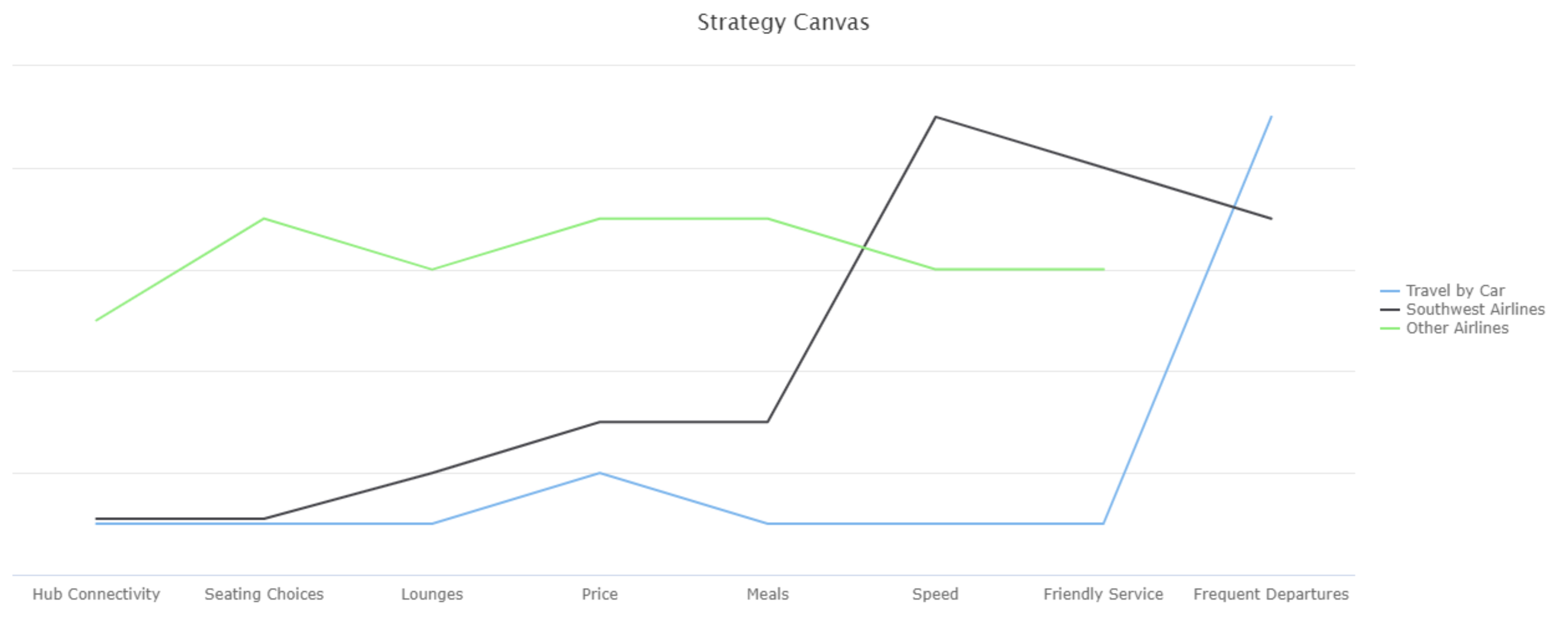
The diagram below shows an example of a Strategy Canvas for Southwest Airlines (based on an analysis from "Blue Ocean Strategy"). It shows how Southwest Airline carved out its strategic differentiation by combining the no-frills, no-hassle convenience and cost of travelling by car with the speed and friendly service of an airline. In fact by removing the airlines' add-ons, Southwest was able to improve on the service and speed they offered. There are many case studies on Southwest Airlines which you can read so I won't go into further details here.


Strategy Canvas for Southwest Airlines

The Strategy Map shown above was drawn with StratNavApp.com, the online collaborative tool for strategists. It's free to use, so why not give it a go?

There are 4 relatively simple steps to preparing your own Strategy Canvas.

1. Identify the competition

The first step to drawing a Strategy Canvas is to know who your competition is. In fact, this is essential to any strategic thinking process. Depending on the nature of your industry, you could identify individual competitors by name, or, as in the example above, you might find it easier to cluster them into a smaller number of semi-homogeneous groups. Don't forget to include your own business, whether you are in the market yet or not.

When identifying competitors, it is always important to look at the problem from the customer's perspective - who or what else could satisfy your customer needs? Had Southwest Airlines not done this, they would simply have listed the other airlines, and not realised that, in many cases, customers are choosing between flying and other modes of transport. It is unlikely they would have had the insight that led to their very successful strategy if they had not taken this broader view.

2. Identify the factors of competition

The second step is to identify the factors that your customers value when choosing the product or service you are offering. In the above example, these include the price, meals, lounges, seating choices, etc.

The simplest way to do this is to actually get out and speak to your target customers, but there are many research approaches you could adopt. Remember, it is important to speak to people who already buy your product and service, people who buy it but from your competitor, and people who don't yet buy your product and service but might in the future (especially if your strategy is successful). And don't forget that people don't always know what they want so you may need to get a little creative in order to find out.

3. Evaluate the competition

The third step is to draw the actual chart - draw a line for each competitor/type of competitor showing how well they perform in terms of each of the factors that your customers value.

It is often interesting to do steps 1 to 3 with a team in a closed room, just to see how different peoples strategy maps look in terms of the competitors/groups they select, the factors they consider important, and how they rate the competition. Strategy Canvases prepared on this basis can be significantly different, and the ensuing debate can be a valuable team building and strategising exercise if managed well.

However, once again, you can also ask your customers directly, just by talking to them or using a variety of research techniques, to get a more accurate and objective picture.

See also: 7 straight-forward steps to master competitor analysis

4. Chart your competitive differentiation

Now you are ready to map your new strategy onto the Canvas. The objective is to chart a line which is substantially different to the lines of any of your competitors/groups. That difference, that unique blend of competitive factors, is your competitive differentiation.

Think about:

  1. Which factors will you increase?

    For example, Southwest Airlines increased the frequency of departures.

  2. Which factors will you decrease?

    For example, Ikea reduced in-store service.

  3. Which factors will you eliminate?

    For example, Southwest Airlines eliminated inflight meals and seating choices.

  4. Which factors will you add?

    For example, Ikea added the ability to take furniture home from the store on the day you bought it, rather than ordering and then waiting for manufacture and delivery.

Of course, not just any differentiation will do. You must pick a combination that a sufficient number of your target customers will find compelling, in order to sustain your commercial objectives. You will undoubtedly have to dig deep into your box of other strategy tools to do so.

There is an art to drawing a really useful Strategy Canvas, but with a little practice, you can learn to draw really insightful diagrams. When you do, they are a great tool for communicating simple but powerful strategic ideas.

Why not share your own experiences with Strategy Canvases in the comments below?

See also:

It's in the numbers

When I first took an interest in business strategy, I shied away from getting too involved in the numbers.

I had a degree in accounting, and, later, an MBA. So I didn't have a problem dealing with numbers. But I didn't want to be seen as a 'bean counter'.

Bean counters, I reasoned, focus on efficiencies and cost cutting. Strategists focus on the big picture. Blue sky thinking. Frameworks and models. Inspiration couldn't be reduced to spreadsheets.

But I quickly realised how wrong I was.

Yes. Strategy is about the big picture, blue sky thinking, frameworks, models and inspiration. But behind all of those things lie the numbers. And until you can get to the numbers, the job isn't done.

Here are some tips for getting to grips with the numbers in business strategy.

1. Go wide

The numbers used in business strategy include but extend well beyond those typically found in financial statements and reports. 

They include demographics and economics; product and process performance. They include market research. They come from within the organisation, within the industry, and from without. They deal with durations and conversion rates, volumes and prices. They look behind hunches and anecdotes to spot trends and structures. They range from statistically valid samples to pure educated guesswork.

It requires imagination and insight to determine what numbers to look for, where to look for them, and how to interpret them.

Triangulating between more diverse source of information increases confidence. Understanding how to reconcile disparate and even contradictory information requires finesse and experience.

2. Examine the relationship between the numbers

The numbers themselves won't tell you much. It's the relationships between the numbers that matter.

I often joke that a lot of my work consists of dividing some numbers by other numbers, until and interesting relationship reveals itself!

Look at the relationships:

  1. Between related numbers (ratio analysis). For example, between inputs and outputs of various kinds. Between revenues and costs; between volume produce and activity to produce it; between work done and people doing it; between market demand and product supplied, etc.
  2. Between numbers (and ratios) over time (trend analysis). Are numbers going up or down or staying the same over time. Charts are helpful in revealing trends. But it is worth getting good at calculating Cumulative Annualised Growth Rates (or CAGR), and doing so across various time periods.
You don't have to be a statistical mastermind - although it almost certainly helps - but it is important to have a work knowledge of quantitative analysis techniques.

3. Ask the right questions

If you want to understand how a business works, and if you want to get good at doing your job, ask how, what, when, where and why.

But if you want to get good at business strategy, you need to go further. You need also to ask how much, how many, how often and how long.

4. Ask what else the data could mean

Don't assume the first 'obvious' answer is the right one. Always consider what other explanations could be leading to the effect you're seeing. And then dig deeper into the numbers in order to confirm which explanation is the more likely and relevant.

For example, I remember seeing some present data which showed that larger investment fund produced higher investment returns. The argument was that larger funds had access to better investment opportunities.

On deeper analysis, it turned out that this was probably not true. The seemingly higher returns were more likely to be driven by the lower operating costs these funds enjoyed through the advantage of economies of scale.

5. Learn to tell stories with numbers

Simply presenting lots of charts and tables and and ratios won't achieve much on its own.

It's important to use the numbers to tell a story. What is happening in this business and industry? What are the possible patterns of cause and effect which explain the data we're seeing? How can we use this understanding to make better decisions about what to do next?

At the end of the day, people won't remember most of the numbers. But they will remember the stories you tell with them as long as they are relevant and compelling.

See this in depth article about storytelling with numbers.

Book recommendation: How to make the world add up - Tim Harford

(The image at the top of this post is partly inspired by one of my favourite films, the Matrix, and in particular the scene in which Neo finally learns to see through the real world to the numbers and code it manifests.)