StratNavApp.com banner ad

Forced compliance is not the same as strategic alignment

Good strategy can be divisive. Any change results in winners and losers. Some people have a strong preference for the status quo above almost any change.  In fact, it is said that if no-one objects to your strategy, it is probably not a very good strategy.

A common response from strong leaders is to demand compliance. "FIFO!" they declare ("Fit in or F off"). Those who oppose are chastised, marginalised and even dismissed.

Strategy almost always requires people to work together to achieve it - so-called strategic alignment. But strategic alignment cannot be demanded, it must be earned. If those opposed to a strategy don't feel free to voice their concerns, then they will simply go underground, proclaiming their support while subtly working to undermine the strategy.

There is, of course, a middle ground. And it is much better than having a strategy so bland that no-one disagrees, or a culture so based on fear that no-one dares to.

The fact is that every strategy has risks and downsides - the bolder the strategy the greater the risks and downsides invariably are. To pretend otherwise is folly. And to dismiss discussion of them denies you the opportunity to better understand and mitigate them.

A good strategist pursues their strategy relentlessly whilst also remaining acutely aware of and actively mitigating the risks.

The solution is to reframe negative criticism into constructive problem solving. Ask questions like:

  1. "Given your concerns about what could happen if we pursue this strategy, what steps might we take to limit the probability of that happening or to limit the impact if it does happen?"
  2. "If you think it won't work, what would have to happen in order to make it possible?"
  3. "If you think that is not how things work, what would it be like if things did work that way?"

When listening to the answer, listen from a perspective of believing that they really are coming at the problem from the perspective of what they believe to be in the best interests of the business. If you can't find that perspective, probe deeper. Look for shared views, rather than differences of opinion, and then use those shared views as a common platform from which to analyse your differences.

You may never convince them to support your strategy, but you will gain a much deeper understanding of the risks and possible mitigating actions. And people who feel they have been genuinely consulted and listened to are much more likely to give you the benefit of the doubt and support your strategy, even despite their concerns, than those who've been marginalised.

And if you find yourself on the wrong side of your bosses strategy, then even if he or she does not ask you questions like that, then simply expressing your concerns as if they were answers to such questions will make them seem more supportive whilst still voicing them.

Of course, there will come times when you simply cannot agree - when you simply want different things for your futures. Perhaps then it really is time to part company. But it is better to part company as friends than as enemies.

See also:

StratML and the StratTech revolution: use cases in the private sector

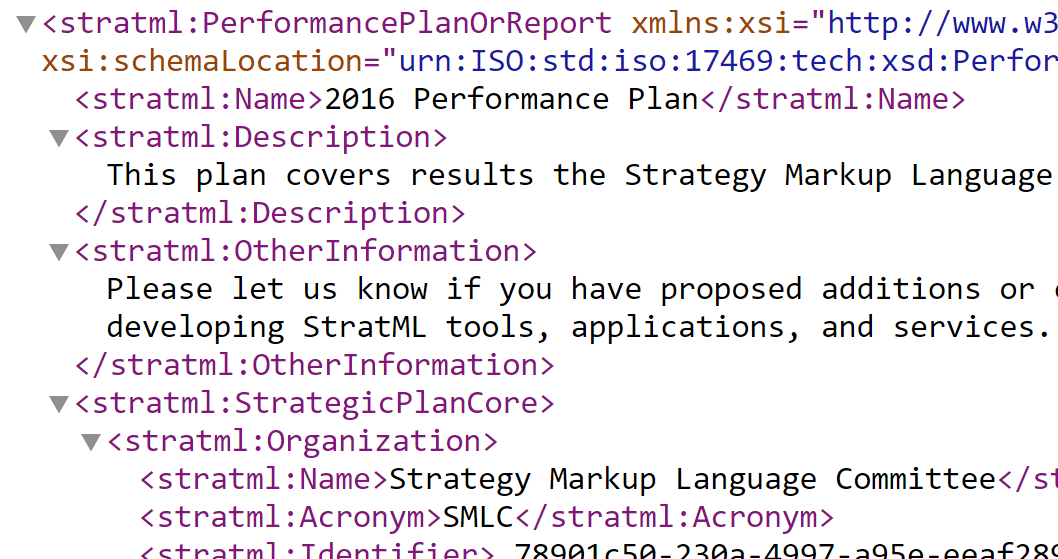
A image showing sample StratML
Sample StratML

What is StratML?

Strategy Markup Language ("StratML") is an XML-based vocabulary and schema for representing the information commonly found in business strategy and performance plans. Part 1 is an ISO Standard (ISO17469-1), whilst Parts 2 and 3 are still under development.

What is StratTech?

Technology has transformed almost every aspect of business: CRM for customer relationship management, ERP for records management, email and social media for communications, etc. by contrast, consultants and strategy departments continue to rely on email, spreadsheets, word processors and presentation tools for developing and executing strategy.

However, new tools, like StratNavApp (disclaimer: I am the founder of StratNavApp) are emerging which use technology to improve collaboration, traceability/auditability, security, and, ultimately, scalability in the processes supporting the development and execution of strategy.

Open standards, like StratML, provide an important foundation on which such StratTech tools can be built.

Use cases for StratML in the private sector

Much of what has been published regarding StratML to date focuses on the public and charity sectors. However, I believe that the implications within the private sector are far more wide-reaching.

I can imagine several use cases for StratML (or future extensions or variations of it) in the private sector.

  • Consolidating strategy and performance plans in large organisations/conglomerates.
  • Submitting strategy and performance plans/prospectuses in the private equity and venture capital sectors.
  • Submitting strategy and performance plans/prospectuses to rating agencies and stock markets.
  • Submitting commercial loan applications.
  • Submitting strategy and performance plans to third-party certification agencies. (Such as Corporate Social Responsibility ("CSR") and other standards bodies.)
  • Submitting fund mandate and performance data to investment platforms.
  • Making strategy and performance plans directly available to fund managers and investment analysts.

Each of these processes requires the creation, transmission and processing of information typically found in strategy and performance plans. As such, StratML could improve them by increasing consistency and making it possible to transmit the information directly from one computer system to another, eliminating the need for people to resort to time-consuming and error-prone cut-and-paste.

StratML remains immature - for now - but should prove to be an important pillar of the StratTech revolution.

I invite you to contact me if you would like to discuss how StratTech and/or StratML could help your business.

See also:

Getting the most out of KPIs

There are two old adages, "You can't manage what you can't measure" (from Peter Drucker) and "What gets measured gets done" (provenance unknown) which apply as much to strategy as to most other things.

That is why I always advocate that you articulate your strategy all the way through to measurements (and targets).

A simple wat to do this is to translate your strategy and vision into goals, break those goals down into SMART objectives, and create measurable KPIs and targets to describe those objectives.

What sounds simple in theory can be extremely difficult in practice, and I see a lot of companies give up altogether, or build dashboards out of the data that is readily to hand whether or not it describes their strategy.

Type of KPIs

In addition, not all KPIs are created equal.

For example, you get:
  • Quantitative KPIs: represent things you can measure using some unit of measurement. Examples include Sales (measured in units sold) or Sales Revenue (measured in monetary terms).
    • Synthetic KPIs: are a subset of Quantitative KPIs where instead of measuring something, you create a score which may be a composite of a range of measureable phenomena. For example, Google's PageRank is a synthetic score calculated for a web page based on the PageRank of every page linked to it combined with an authority score for the author of the page. Net Promoter Score (or "NPS") is another example calculated using a defined formula determined from customers' answers to a simple question.
  • Qualitative KPIs: represent things you can categorise and rank. Examples include high, medium and low or variants thereof, or initiatives which are recorded as moving through stages (initiation, analysis, design, development, testing, deployment live, etc.)
  • Binary KPIs: represent things that either are or are not. Examples include initiatives which are shown as being on track (or not), or complete (or not).

Information Content

Different KPIs provide different amounts of information content. Quantitative KPIs, especially very granular ones, tend to have the highest information content. Qualitative KPIs have less information content: if a KPI is high, how high is it? If it still high in the next measurement period, is it higher or lower than it was the previous time? Likewise, if a KPIs shows a stage in a process, how close is it to moving to the next stage? Unidirectional binary KPIs contain the least amount of information: for an example, an initiative is not done, right up until the point it is done, after which it can never be not done again - it will ever only yield exactly one bit of information.

For this reason, I always prefer quantitative KPIs over qualitative KPIs, and I avoid binary KPIs, especially unidirectional binaries, as much as is humanely possible. Invariably, I find that qualitative KPIs and binary KPIs can be translated into quantitative KPIs, but that is perhaps a subject for another post.

Objectivity and verifiability

A second consideration in selecting PKIs is how objective and verifiable they are. For example, quantitative KPIs which come directly from a business's independently audited financial statements tend to be quite objective (although not always very strategic).

Subjective measures can be made more objective (and often more quantitative at the same time) by average the opinions of large numbers of people (this is how Net Promoter Scores work, for example).

Qualitative or binary KPIs based on one person's (or a small group's)  opinion, on the other hand, are much more open to bias. I am sure we have all seen initiatives declared as complete by politically motivated sponsors when everyone knows that key outcomes have not been delivered.

Including projects on strategy scorecards

As a category, KPIs for the completion of projects deserve special mention. I am personally not a fan of including these in strategy scorecards because (1) the usually have low information content (as outlined above), (2) quickly become political and subjective (also as outlined above) and (3) you either clutter your scorecard by including every initiative in the organisation, or are forced to make subjective choices about which to include and which to exclude.

Much better I believe, is to focus the strategy scorecard on the strategic outcomes to be achieved by the projects. This has the added benefit of rewarding agile projects which deliver some benefits early, over higher risk 'big bang' projects which backend all of the benefits and which are problematic in their own right. As a side note, if part of the organisation's strategy is to improve its execution / project delivery capability, then I think there are more than enough quantifiable capability metrics that can be aggregated across all projects.

Conclusion

KPIs are powerful enough to make or break a strategy, and they are notoriously difficult to get right. They can be used to minimise the interference from (corporate) politics, and drive execution. Extreme care and diligence should be applied when setting them.

How should strategists respond to the US election result?

Yesterday (Wednesday), we learned something very important that we didn't know on Monday. We learned who will be the next resident at the Whitehouse.

You may have hoped for, anticipated, predicted or even expected either this outcome or the alternative outcome, but that is now in the past. Irrelevant. What was a possibility is now a (near) certainty.

As strategists, it is not our job to happy, sad, fearful or even angry at such outcomes. But it is our job to help our clients / employers / stakeholders to understand and respond to such developments in the most constructive way possible.

How can we do that? Here is a 4-step playbook:

Step 1: Update your PESTEL analysis

The first step would be to update your PESTEL analysis, particularly the P element which represents the Political trends, threats and opportunities your business faces (and maybe also the E element which represents the Environmental trends, threats and opportunities).

We know from president-elect Trump's campaign speeches what policies he would like to enact. The probability of those policies being enacted has now increased significantly. Note, that they are still not certain. Trump would not be the first political to fail to deliver on his campaign policy pledges and so our strategies should allow for political failure and compromise. But they are definitely more likely. At the most macro level, these changes are likely to impact free trade, energy and environmental policy, and minority groups' rights / diversity.

Your PESTEL analysis should include the possible macroeconomic consequence of implementing or failing to implement these policies in terms of trade, foreign exchange, GDP growth, employment, interest rates, etc. You should take into account not just direct action by the US government, but also how other US institutions and other nations might respond.

STEP 2: Update your competitor and business model analyses

Having considered these macroeconomic impacts, the second step would be to consider the microeconomic impacts. How might your competitors, suppliers, distributors and customer respond or be impacted by the policies and macroeconomic consequences outlined above. This should cause you to revisit your competitor analysis as well as your business model analysis.

STEP 3: Update your scenarios

Thirdly, your should review your scenario analysis to take into account the macro- and microeconomic insights generated above. It may be that your existing scenarios just need fine-tuning, or you may find that the changes are significant enough to warrant the development of completely new scenarios.

STEP 4: Review your open strategic decisions

The fourth and final step is to re-evaluate, and where necessary change your strategic goals and plans. The plans you have today were based on the analysis you did before this new information became available. It is, therefore appropriate to refresh your decision matrices and re-evaluate your decisions. For example, a European wind-turbine manufacturer with plans to expand into the US may now consider it more prudent to focus its investment elsewhere.

In re-evaluating your strategic goals and plans it is important to consider the sunk costs incurred since the decision was already made. If the European wind-turbine manufacturer has already committed 90% of the investment required to enter the US market, it may still make more economic sense to spend the remaining 10% than to start from scratch in another market.

BONUS: Don't wait for your annual planning cycle

Too much strategic thinking and planning is tethered to organisations' annual planning cycles. You may have just completed yours for 2016. But events of significant strategic importance follow their own timetables. That is why strategy should be a continuous and fluid process. If you wait until your next annual cycle you may find your competitors have stolen a march on you.

The largest economy in the world has elected its next leader. He has made it clear that he plans to change much. This will have consequences for all of us, wherever we are in the world. As strategists, it is our job and our professional responsibility to understand those changes and how to take them into account in helping our clients, employers and other stakeholders. So, let's crack on.

PROMOTION: StratNavApp is designed to make it easier for you to do strategy on a continuous and collaborative basis. If you've not already done so, why not try it now?

How (and why) to fit your Strategy On A Page

Your strategy should clearly communicate direction and priorities. Whilst it may take a lot of detailed analysis and discipline to develop and execute a strategy, once it is done it is important to be able to clearly articulate it in a way that people who've not been involved in the detail can easily understand.

The strategy-on-a-page (SOAP) is a good technique for communicating a strategy more widely. By sticking to the one-page discipline, it forces the architects of the strategy to really boil it down to its essentials.

Of course, it must still include all the basic ingredients:

  • Underlying insights / rationale
  • Purpose (vision / mission) and values
  • Themes / priorities (often referred to as the 'pillars' of a strategy)
  • Initiatives, including some explanation of time and sequence
  • Outcome measures and targets

Here is a template I've used to good effect before.

Here are some tips for completing your own SOAP:

  • Summarising the analysis underpinning your strategy into a small number of pithy facts about the current situation will help to ground it in a world your audience already understands. Between 4 and 6 statements should provide sufficient clarity without losing focus.
  • You probably don't need a vision and a mission on your SOAP. Either will do. Just pick the one most likely to capture galvanise people into action. 
  • Whilst brand values describe how you want customers and partners to experience your business, staff values describe how you want your team to behave towards each other and customers. You may feel these should be the same and only one set of values is enough. If you do have two, make sure they are clearly aligned.
  • The strategy ambitions describe at the highest level what you want the strategy to achieve, and provide an organising framework for the detail so that it is clear how the individual parts go together to make for a greater whole. Again, between 4 and 6 should provide sufficient narrative whilst retaining focus. 
  • Organising the initiatives into "First...", "...then...", and "...and finally" allows you to express the detail of your delivery plan in story-like language without getting overly hung up in the detail. This detail must still be tightly managed, but not on your SOAP. I often see these initiatives chunked up into large programmes. That is fine as a management technique, but it does make the strategy delivery harder for people to relate to. Resist the temptation to fall back on patterns like "First analysis, then design, and finally delivery", as this adds no narrative value. Focus instead on phasing and sequencing of delivered changes.
  • Select a small number, say 2 or 3, KPIs to represent each theme. Use visual icons to indicate, for example, whether you intend for the KPI to be increased, reduced or kept the same. Combine KPIs which represent the change in behaviour of the organisation (e.g. operational changes) with KPIs which show the result of such changes (e.g. growth and financial outcomes).
  • Update your SOAP periodically to reflect progress with the initiatives and KPIs, as part of a programme of celebrating small successes within the context of the overall plan.

A SOAP is a powerful tool when used as part of a larger strategy communication programme. It should never be your only communication, though! It can serve as a useful leave-behind. Hang copies around the office immediately after a town-hall or roadshow presentation on the new strategy as an ongoing reminder.

Contact me if you'd like this template in Powerpoint format, or need help developing your own SOAP.

The annual home insurance dance - Or - how to rebuild consumer trust

I renewed my home insurance over the weekend. I do it every year, of course, and every year it is pretty much the same.

Here is how the conversation typically goes:

Ins Co: (automated voice) Your call is important to us. We're experiencing unusually high call volumes at the moment, so it may take us longer than usual to answer your call.

Me: (under my breath) You're always experiencing 'unusually high' call volumes. Maybe you should start to call this level of call 'usually high' and staff your call centre processes appropriately. On the other hand, if you're process worked properly, I wouldn't need to call you and  we wouldn't be here in the first place.

Ins Co: (answering the call quite quickly, leaving me wondering why they'd wound me up about having to wait a long time first place!) Hello, this is ..., how can I help?

Me: I've received your renewal quotation, and I'd like to not accept it.

Ins Co: (after completing ID&V) Of course. Do you mind if I ask why?

Me: Because it is much cheaper (16% this year) to take out a new policy with you than it is to accept your renewal.

Ins Co: Oh. Would you like me to see if there is anything I can do to reduce your renewal?

Me: No, don't bother thanks. You try every year and even though you do reduce it, it is always still higher than the new policy cost. I don't know why you don't give me your best price in the first place? Anyway, I've taken out the new one already over the internet, so can we please just not renew the old one?

Ins Co: OK, that's done now, is there anything else I can do for you?

Alright, that's not the exact conversation. I am less blunt than that with the operator. I know it is not her fault.

But a simple renewal has been turned into a much more complex cancellation and new policy, with a phone call and twice as much paperwork and postage. Why I can't do the cancellation over the internet (perhaps you can, but I couldn't figure it out) and why there is any paper and postage involved in this day and age is a completely different question. The whole process is quite simply annoying.

So why do I stay with this insurer? Quite simply because, hassle factor included, it is still the best deal I can find (every year, I cross check the deal with a few other insurers).

Now I am pretty sure I know what is going on here. By taking out a new policy, I benefit from a much more attractive rate designed to attract new business. The renewal, by contrast, is much more expensive as the insurance company is relying on customer apathy to claw back the profits they sacrificed in the first year, despite the fact that a renewal must surely be cheaper to process than a new policy.

And I am guessing that enough people simply accept the higher priced renewal to make it worth the insurance company's while. I also suspect that, because I take out a new policy with the same insurer every year instead of renewing, that they make much less profit from me as a customer than they otherwise would.

It is a process which is broken on many levels. As a customer I face two choices: (1) pay more than I need to at renewal, or (2) go through a convoluted and annoying cancellation and new policy process. Neither options seems like a win from my perspective.

I've been with the same insurer for many years now. I should be a loyal customer - even an advocate. Instead, I tolerate them grudgingly.

As an industry, we spend a lot of time talking about rebuilding consumer confidence and trust. It is in fixing broken processes like these that we need to start.
photo credit: BAM BAM via photopin (license)

Transparency versus democracy in decision making

One of the key lessons of the Brexit vote was that important decisions should not be made by direct democracy. On the one hand, the referendum showed that voters had lost confidence in 'the experts'; on the other hand, it showed that they were ill-equipped to make the decision themselves.

That is the very reason why most democracies are representative democracies and not direct democracies. (In a representative democracy, the people vote for 'experts' to represent them in making the important decisions. In a direct democracy, the people vote directly on the important decisions themselves. The challenge, in a representative democracy, of course, is for the representatives to retain the confidence of the electorate - which they clearly failed to do during the Brexit referendum!)

It is the same in organisations. Whilst much has been written about increasing employee participation in order to increase engagement, it remains management's responsibility and prerogative to make the important decisions.

Where does that leave employee engagement? A better way to increase employee engagement is through transparency. That is, by explaining to employees how and why important decisions are made, both before, during and after the fact.

Of course, this assumes that management is making high-quality decisions in an informed and reasoned basis in the first place. If this is not the case, then increasing transparency will just expose these flaws to employees, which will decrease engagement and confidence.

The models we typically use in strategy development and execution play two roles in this regard.

Firstly, by using the appropriate models well, decision makers are able to increase the quality of their decision making. The models help decision makers to develop richer pictures of the organisation and its competitive environment, to ensure that a wider range of alternatives is considered before making a decision, and to ensure that the alternatives are evaluated against all of the appropriate criteria before a final decision is reached.

Many leaders continue to make important decisions based on intuition. This is appropriate for less critical decisions: intuition is, after all, the sum of all of our experiences. However, research has shown the importance of visual cognitive artefacts (such as mind maps, SWOT analyses, and decision matrices) that extend the capacity of the brain to process information (see Stop jumping to solutions!). That is, clearly articulating your thinking on paper (or a screen) using models improves everyone's abilities.

Secondly, the models facilitate communicating those decisions to employees, and therefore promote transparency. Because the analysis has been both thorough and explicit, it is more easily revealed to employees. Employees in turn will see that management really has understood the issues and evaluated all of the alternatives and will be less likely to assume that decision makers are living in ivory towers, out of touch with what is really going on in the business, and pursuing their own hidden agendas for personal gain at the expense of the organisation as a whole.

For example, almost all options have both pros and cons. An important part of transparency is revealing both the cons of the alternative selected, and the pros of the alternatives not selected (rather than simply presenting the selected alternative as being unambiguously positive). By understanding the cons of the alternative selected, employees will be better able to recognise and minimise any downsides as they arise.

Of course, there will be some decisions where management cannot be transparent. This might occur, for example, where there is market sensitive information in a complex negotiation. However, if decision makers are transparent wherever they can be, employees will be more likely to accept where the decision makers explain that they cannot be.

The judicious use of models can significantly improve the quality of decision-making whilst also improving transparency and employee engagement. StratNavApp.com, the purpose-built online environment for collaborative strategy development and execution was developed with just that in mind. Why not give it a try now?

Post-script: I have used the terms 'management', 'employees', and 'decision-makers' rather loosely as if they are discreet groups of people. In truth, most organisations exhibit some form of hierarchy and specialisation with at least some devolution of decision-making. That is, the same individual may be 'management' and a 'decision-maker' with regard to some decisions, whilst simultaneously being an 'employee' with regards to others. Whilst this may make the flows of communication and transparency more complex, the principles outlined above will still apply.

Understanding 4 different types of growth with Ansoff's Matrix

Most businesses are obsessed with growth. Growth is by no means the only strategic goal worth pursuing. But it is certainly one of the more common ones.

Growth has many benefits. It:

  • creates economies of scale,
  • creates employment,
  • generates shareholder returns,
  • bolsters executives' egos, and of course
  • means more customers getting more of the products and services they want.

A business which is growing, especially one which is growing relative to its competitors, is seen to be winning.

However, not all growth is always good. Growth can lead to bureaucracy, diminishing marginal returns, diseconomies of scale, and dispersion of focus.

Ansoff Matrix
Ansoff's Matrix

When looking at growth, H. Igor Ansoff showed with his now famous matrix in 1957, that there are at least 4 different types of growth.

  • Market Penetration: selling higher volumes of the same products and services into existing markets.
  • Product Development: developing new products or services to sell into existing markets.
  • Market Development: finding new markets to sell existing products or services to.
  • Diversification: selling new products or services to new markets. This is the most risky of the four on account of it having to deal with two unknowns at the same time.

There is more to these four growth strategies than meets the eye, so we will look at each of them in turn.

1. Market Penetration

For most businesses, market penetration is the default strategy. Of course, if the market itself is growing, then, all other things being equal, the business will grow along with it. They say that "all ships rise with the tide".

Normally, however, market penetration would seek growth relative to the market. There are a number of ways to achieve this:

  1. Volume-selling: selling larger quantities of the same product to existing customers. You can do this by increasing distribution and/or offering volume discounts.
  2. Up-selling: selling higher-value products to existing customers. For example, a more expensive model.
  3. Cross-selling: selling additional products to existing customers. These could be add-ons or complementary products.
  4. Competition: convincing customers who would otherwise have bought from your competitors to buy from you instead.
  5. New customer development: finding customers within the market who are not already using the product or service at all, and convincing them to start.

You can achieve market penetration by tweaking the marketing mix. That is, by reducing price, increasing promotion and/or distribution, tweaking product features or packaging, etc.

You can also achieve market penetration by acquiring a competitor.

2. Market Development

Market penetration can involve developing new markets in a number of ways:

  1. Entering a new geographic region. This could be a new region or country.
  2. Targeting a new customer segment. For example, the youth market, or small-to-medium enterprises. Success in this strategy depends on how insightful and nuanced your customer segmentation is in the first place.
  3. Developing new distribution channels. For example, expanding from wholesale into retail distribution, or targeting a different type of distributor.
  4. Expanding from the consumer to the corporate or public sectors, or vice versa.

The exact means of entering those markets will depend on numerous factors. These include different regulatory regimes, different socio-economic norms, and whether a competitor already exists in the market or not.

3. Product Development

Product development may take the form of:

  1. New product development: Research and innovation in order to create something which the world has never seen before.
  2. Product licensing: Acquire the rights to manufacture a product developed by someone else.
  3. Product sourcing. Select products which already exist elsewhere (in other geographies, or through other distribution channels) and make them available to your customers. Amazon is a great example of this approach.

Which of these are most suitable depends on many different factors. Key of these is whether the business is fundamentally predicated on technical product or service development expertise and innovation (like Apple), on manufacturing expertise (like Capita), or on customer intimacy (like Amazon).

New products exist in a continuum from:

  • completely new and novel products, through products which are 
  • reconfigurations of existing products, to products which are merely
  • incremental improvements to existing products.

The resulting products may be own-labelled, co-branded or white-labelled.

4. Diversification

Diversification is the most risky of the four strategies. This is because it involves all of the complexity and risk of Market Development and Product Development at the same time.

This is why businesses often pursue diversification through acquisition. That is, by acquiring a business or team which already has a track record of selling those products or services in those markets. Even then, the acquirer's ability to understand and oversee the acquired business may be a challenge.

Application

You can use Ansoff's Matrix can to understand strategies in hindsight. However, it is more powerful to use it to help businesses generate a complete list of strategic options for subsequent evaluation. See, for example, 6 techniques and 5 tips for developing strategic options.

As we have shown, Ansoff's Matrix provides not just the four options shown in the diagram, but also a range of variations within each of the four.

Book Review: The Black Swan, by Nassim Taleb

The central premise of the Black Swan, by Nassim Taleb, is that rare outlying events have a greater influence on the world than do statistically predictable ones, but whilst our planning and analysis systems deal with the latter reasonably well, they are completely inadequate for the former.

Examples of rare outlying events that have had a significant event on our world include 9/11, the 2008/9 stock market crash, and, more recently, the UK #Brexit referendum.

Taleb does a reasonably good job of pointing out the flaws in what he terms the Gaussian model (most notably the normal distribution). He also does a good job in demonstrating our tendency to want to try to describe everything in these terms, regardless of whether or not it is appropriate, and therefore to tend to ignore everything that falls outside of this model.

However, he does err towards throwing the baby out with the bath water. The normal distribution (and indeed the other distributions he criticises) are useful in many applications. And that should be the real measure of any theory. All theories have limitations and domains beyond which they should be used, and yet remain useful if appropriately applied, and statistical distributions are not different in this regard.

He also fails to present any useful alternatives, and so does not really take us forward in any meaningful way. Thinking about it from my own perspective, scenario planning does provide one useful alternative which can help us to escape the confines and flaws of the so-called Gaussian model.

The Black Swan is a fascinating and eclectic read which may challenge many of our assumptions about the world and the way we analyse it. However, if you're looking for practical alternative solutions, you may be disappointed.

Using online business strategy development and execution tools to increase collaboration

The digital revolution is transforming almost every aspect of almost every business. As strategists, it is important to remain abreast of these trends in order to be able to advise our employers or clients appropriately.

But there is one aspect of the digital revolution we often overlook. And that is how digital can change the way we do strategy itself.

Most strategy processes still boil down to circulating large Powerpoint decks or Word documents by email. Just like we did 30 years ago.

Fortunately, that is now starting to change. StratNavApp.com is an online business strategy development and execution tool designed to:

  • ensure best practice,
  • improve consistency,
  • increase collaboration, and
  • leverage the power of AI in your strategy processes.

StratNavApp.com is arranged around a unique Strategy Board. This brings together the 4 core stages of the strategy development and execution cycle:

  1. Analysis
  2. Articulation
  3. Planning
  4. Control

Analysis

The Analysis module is all about understanding the current situation and anticipated future(s). This includes the organisation's

  • operating model: capabilities, strengths and weaknesses,
    as well as its
  • operating environment: competition and industry forces and trends.

This understanding provides the WHY of your strategy.

StratNavApp provides a number of tools for doing this, such as:

  • The Business Model Canvas. Summarise exactly how the business works (Learn more.)
  • Porter's Value Chain analysis. Understanding how the organisation uses its operating model to create value. (Learn more.)
  • McKinsey 7S analysis. Understand the internal factors which lead to success. (Learn more.)
  • PESTEL analysis. Understand the Political, Economic, Socio-economic, Technological, Environmental and Legal trends. (Learn more.)
  • Porter's 5 Forces analysis. Understanding the forces that shape competition in your industry. (Learn more.)
  • Strategy Canvas. Compare and contrast how different competitors win customers. Differentiate your the organisation from the rest of the market. (Learn more.)
  • BCG Matrix. Understand how different products and services in a portfolio contribute value. (Learn more.)
  • SWOT analysis. Summarise the organisation's Strengths, Weaknesses, Opportunities and Threats. (Learn more.)
  • Scenario Analysis. Deal with uncertainty. (Learn more.)

The different models are all integrated behind the scenes where this makes sense. For example, the insights generated in the other tools will automatically show up in your SWOT analysis. You can also attach them to processes in the Value Chain analysis, etc.

Articulation

The Articulation module is where you express WHAT your strategy is. StratNavApp.com allows you to articulate your

  • Vision
  • Mission and 
  • Values

You can also set your strategic

  • Goals,
  • Objectives
  • Key Performance Indicators (KPIs),
  • Targets and Actual Results
using a Balanced Scorecard framework.

The Scorecard provides a useful summary of your Goals, Objectives KPIs and Targets. (The scorecard is in the Control quadrant.) It also helps you identify any gaps in your strategy.

The Strategy House provides a handy summary of your strategy. This is particularly useful for communication.

Planning

The Planning module allows you to map out exactly HOW you plan to deliver your strategy.

Initiatives move through various stages, such as proposal, approval, delivery and completion.

You can also organise your Initiatives in:

  • a timeline or Gantt view. 
  • a Three Horizons view, helping to ensure you strike the right balance between short, medium and long-term activities.
You can link Initiatives back to the Goals they support. And you can capture Cost and Benefit details.

The Goal/Initiative Matrix allows you to map your Initiatives to your Goals. It highlights

  • any Initiatives which don't explicitly support your Goals, or
  • any Goals which don't have any initiatives supporting them.

The Initiative RASCI helps you to ensure that the right people are involved in the right initiatives in the right roles.

The Initiative/Scenario Matrix helps you test the robustness of your initiatives against the uncertainties you identified in the Analysis phase.

Control

The Control module runs across the other modules. It provides tools to assist in the development and execution of your strategy. To make sure it actually gets done!

A RAID log allows you to record Risks, Actions, Issues and Decisions. You can also link these to your to the appropriate items within the other three modules. (Learn more.)

You can also record Stakeholders. These are either Individuals, Organisations or Generic Groups. Using a RASCI framework, you can map them as being either Responsible, Supporting, Accountable, Consulted or Informed for Goals, Initiatives or Actions.

The Meeting Manager allows you to plan and record all of your meetings. You can record which Stakeholders participated in which meetings. You can also record Agendas, Minutes, Actions and Decisions. The Actions and Decisions are automatically included in the RAID log. You can also then link them back to the relevant Insights, Goals and Initiatives, etc.

Lastly, the Scorecard provides a graphical summary of all of your KPI's Target and Actual Results. This allows you to easily track if your strategy is delivering. You can also feed this back into the ongoing Analysis and refinement of your strategy.

Collaboration

Collaboration is baked into StratNavApp at every step along the way.

To invite someone into your strategy project, simply enter their email address. StratNavApp will then email them with appropriate instructions which will then link them to your project. Only people you invite can see your strategy projects.

All changes are recorded, using a familiar legal red-lining approach where applicable. They also timestamped together with the author who made them. So you'll always know who did what and when. There is also a handy notes feature allowing teammates to annotate and comment on any element of your strategy. This ensures that all collaboration around your strategy remains attached to the strategy content to which it relates. No more trawling through email archives and old versions of documents to remember who said what when!

Once a day, StratNavApp will email you a summary of all the changes and notes your teammates have made, ensuring you're always up to date and engaged in the conversation.

Reporting, Search, File Archive & Multi-device

The Reporting module enables you to extract a snapshot strategic plan at any stage in your journey. Because it is a dynamic snapshot at a point in time, your strategic plan truly becomes a "living document", not an annual report which just sits on the shelf until next year.

You can also export your strategy plan into Strategy Markup Language (StratML). StratML is the ISO Standard XML Schema for Strategy and Performance Plans and Reports.

Your projects are also fully searchable, and available from any device connected to the internet, be it a PC, laptop, tablet or smartphone.

And you can upload files/documents and attach them to your analysis and initiatives. So the industry report you needed is always right there when you need it. And the business case spreadsheet is always attached to the initiative.

Give it a go, NOW

StratNavApp is free to use for up to three projects. If you want to do more than three projects, there is a subscription version available for a small monthly fee. Enterprise licenses are also available.

Why not click here to give it a go, now?

Data Analysis Lessons from "The implications of Brexit for monetary policy"

I recently attended Martin Weale's valedictory speech as a member of the Monetary Policy Committee (MPC), which was entitled: "The implications of Brexit for monetary policy", and was hosted by Resolution Foundation.

The session consisted of the speech itself, follow by panel comments from Sushil Wadhwani (economist and former MPC member), Chris Giles (Economics Editor at the Financial Times) and
Melanie Baker (UK economist at Morgan Stanley), followed by questions from the audience to the speaker and panel.

Martin Weale's speech was fascinating enough in its own right. However this is not a blog on economics or monetary policy, and so I will not even attempt to do it justice here. (If you're interested, you can read the speech itself here, and Resolution Foundation's write up of the event here.) Rather, I will pick up on two related points Sunil Wadhwani made in his remarks, and which I think have direct pertinence to business strategy.

1. Having the data is not enough


Martin showed two separate charts, one showing the weakening of the exchange rate, and the other showing the fall and recovery in the FTSE100 and the fall and not recovery in the FTSE250 immediately following the referendum. He suggested that the fall in the FTSE250 was more representative of sentiment regarding the UK because so much of the FTSE100 consisted of expected foreign earnings from multinationals with UK listings. He then suggested that the fall in the FTSE250 was not significant enough to allow one to draw conclusions (and did little more than confirm that "prices can go down as well as up").

Sunil countered that a better measure of confidence in the UK economy would be the FTSE250 in dollar terms. This had taken a pounding following the referendum, and painted a much more negative outlook than Martin had suggested. (This effectively combines the two charts.)

Whether you agree with Martin or Sunil, the exchange was a potent reminder that its not just what data you have, but also how you analyse it.

It reminded me of a project I worked on some years ago where the data we were seeing was showing a slight decline in the performance of a particular process. Because the decline appeared to be only slight it was not ringing any alarm bells (yet). However, I knew that the process (a) dealt with 6 discrete populations and (b) included a natural delay of some months. So I requested the underlying source data, and (1) split it into the populations, and (2) did a batch cohort analysis of each. This analysis revealed a much deeper - up to 50% for some populations - decline in process effectiveness. That definitely started the alarm bells ringing!

Yes, subtly improper analysis of data can render it very misleading!

2. You'll never have all of the data or analysis


Sunil further responded to Dr Weaver's conclusion that the data was still inconclusive by remarking that:
"You have to form judgments; because you are never as well informed as you would like to be; because the data is simply not there." (Tweet this!)
He went on to advise:
"Resist the temptation to wait for more data before acting. There will always be more data to wait for." (Tweet this!)
(That is my best recollection of the words that he used, but I cannot guarantee that it is verbatim.)

That is one of the key lessons I remember from the many case studies we did on my MBA programme. (I sometimes think that part of the objective of an MBA programme is to overload you with case studies and then put you on the spot in class in front of your peers to draw conclusions from what is inevitably inadequate data, as that is the closest they can get to what it feels like in real life within the classroom context!)

Its a lessons that has stood me in good stead ever since. In any strategic process, there is a time to collect more data, a time to conduct deeper analysis, and a time to accept that what you've got is good enough/as good as you're going to get and its time to make some decisions and move forward.

If you fail to learn that lesson, you invariable fall into 'paralysis by analysis': where data and analysis snowball and any chance of meaningful action falls by the wayside.

Conclusion


Data is a strategist's friend. It is the bedrock of analysis, reasoned decision making and feedback. But it is not without its pitfalls. Good use of data is as much an art as it is a science. And it is one every strategist does well to study carefully.

How to deal with chronic uncertainty (like Brexit) in business strategy

Deer in headlights

I've just read (yet another!) blog post advising business owners on what to do about Brexit. The conclusion: there is so much uncertainty about the outcome that business owners should just ignore it and carry on as if nothing had happened.

I have seldom heard such poor advice!

In the first instance, uncertainty is no excuse for burying your head in the sand. We live in uncertain times, and if it were, no-one would ever do anything. As a discipline, strategy has tried and tested ways of dealing with uncertainty.

Secondly, we now have significantly more information about the future than we had 3 weeks ago. To ignore that information would be myopic and foolish.

So, how does one deal with chronic uncertainty in a structured and proactive manner? Here is a 6-step approach:

1. Get the facts

After a referendum characterised by misinformation, it is important to remain appropriately informed. Key questions include:

  1. What is the legal status of the referendum, and what, if anything could overturn it?
  2. What is the actual process, steps to be taken, and timelines for leaving the EU? 
  3. Who are the decision makers and power brokers, in both the UK in Europe, and what are they saying and doing?
  4. What models exist for subsequent engagement with the EU and what do they entail?

Ignorance breeds fear, so get informed.

2. Identify possible outcomes

Following the referendum, there are a number of possible outcomes. At the highest level, these might include:

  1. The UK does not leave the EU.
  2. The UK leaves the EU under favourable terms (so-called Brexit-light).
  3. The UK leaves the EU under unfavourable terms.
  4. The UK leaves the EU, followed by other countries exiting and ultimately, the collapse of the EU itself.
  5. The UK splits, with Scotland remaining a part of the EU and the rest of the UK exiting.

There are, of course many other combinations and permutations which might be worthy of consideration. Whilst it is probably impractical to consider them all, it is important to consider a wide range of possible outcomes.

3. Understand the circumstances and implications of each possible outcome

Within each possible outcome, it is important to develop an understanding of:

  1. What are the future developments and circumstances which might make that outcome more or less likely to emerge, and
  2. What are the implications of that outcome, in general, and for your business specifically.

It is important to develop as vivid a narrative for each possible outcome as is possible. That is, write a plausible story for each outcome a logical chain of actions, events and their consequences. The more vivid the narrative, the more instructive it will be in planning your response.

4. Implement an early warning system

Once you've identified the circumstances which might make it more likely for one outcome to emerge than another, you need to use that as a lens for monitoring developments on an ongoing basis. Make specific people responsible for monitoring specific issues and reporting them to the broader group on a regular basis. Review all of your plans every time there is a major development. Know in advance when you intend to act, and when you intend to sit tight and watch.

Include relevant factors into your competitor analysis (see 7 straight-forward steps to master competitor analysis) to keep one step ahead of the competition.

5. Prepare plans in advance for the most likely outcomes

Don't wait for your early warning system to tell you that something has happened. It's too late to start planning then. Prepare contingency plans for each of the possible outcomes. Add more detail to your plans as events develop and some outcomes become more likely, leaving the plans for the less likely outcomes. You don't need to execute your plans now, but you do want to know in advance who will do what when key outcomes do emerge.

The plans you develop for each of the likely outcomes may be different to the normal plans you'd implement for, say, the implementation of a large system. Plans should emphasise "if this then that" logic, review and decision points and accountabilities, and clear criteria for deciding when to push forward and when to hold back.

You may find that from your plans there emerge some actions which you'd take in the event of many or all outcomes, which expand the options available to you, and/or which are relatively inexpensive to complete. You may then decide to proceed with these "no regrets" actions immediately.

6. Deal with the uncertainty now

The preceding 5 steps deal with planning ahead for what might happen. But there are also things that you could be doing to better cope with the uncertainty right now.

In the case of Brexit, there are at a number of likely immediate considerations:

  1. How are you suppliers, distributors and customers responding? For example, if business partners (especially foreign ones) are less inclined to enter into long-term contracts because of the uncertainty, how could that impact your business and your existing plans for growth or expansion and how will you respond? What could you do to help your partners overcome any such reticence.
  2. A Brexit will inevitably place a huge demand on legal, regulatory, compliance and strategy resources. Do you need need to secure resource in advance, or risk losing out when there is a mad rush at the last minute (as some experienced as the Solvency II deadline approached)? What regulatory or competitive initiatives will be put on hold as regulators and competitors divert resources to deal with their own Brexit plans, and what will you do with the breathing space that might offer?
  3. What are you doing to re-assure your staff, customers and partners that

Chronic uncertainty certainly complicates strategy, but it also offers many opportunities. It is important not to get stunned into inaction, like a deer caught in the headlights. Proactivity remains key to success.

For a confidential conversation about what Brexit might mean for your business, or how to deal with uncertainty in general, please contact me.

See also:

7 steps to master competitor analysis for business strategy

A robust competitor analysis is an essential component of any strategy analysis.

There is a wealth of easily accessible information available on the Internet. And so it has never been easier to compile a successful competitor analysis.

However, without a plan, that wealth of information can seem like a fire hose. It can flood you with information. This can make it difficult to see the forest for the trees.

And competitors are continually changing and evolving. So competitor analysis must be an ongoing programme, rather than a one-off exercise.

This article outlines a simple plan to help focus and sustain your competitor analysis effort.

1. Identify your competitors 

This may seem almost too obvious to mention. But depending on your industry, it can be quite difficult to identify exactly who your competitors are.

Your competitors are anyone your customers could turn to, other than your business, to solve the problem or fill the need you aim to solve or fill for them.

(Note: Some writers sometimes distinguish between direct competitors and indirect substitutes. But for the purposes of this article, we consider these to be the same.)

In fast-moving industries, it is easy to be caught unawares by the entry and sudden growth of a competitor before you were even fully aware of their presence.

Industries with rapidly changing consumer preferences may be particularly susceptible to substitution. For example, competition for a local restaurant might not come only from other restaurants, but also from a local grocery store stocking ready meals.

Knowing your local market well may no longer be enough. The Internet can make it easier for competitors to come at you from almost anywhere in the world.

One way to identify competitors is to talk to people. Your staff/colleagues may have worked at your competitors or know people who do. Your customers and suppliers may also do business with your competitors. Or they may have been marketed or pitched to by them.

These conversations can be in the form of formal research or just casual conversation.

Trade bodies, shows and publications, where available, are another source of valuable intel.

2. Segment your competitors

Once you've identified your competitors (and possible substitutes) you may find you end up with quite a long list. If your list is too long, and you try to analyse them all, you may find that you are unable to do justice to any of them.

The solution is to segment them. There are two different ways you can approach this.

  1. Divide your competitors into different groups which behave similarly. Then you can simply monitor one or two competitors within each group and extrapolate your analysis to the group at large.

    There is clearly an inherent risk here. So it is important to confirm your groupings from time to time.

  2. Divide your competitors into high, medium and low groups depending on how much of a competitive threat they represent. You would then do a more thorough analysis of the first group and a more cursory analysis of the third group.

    Part of your analysis of all three groups will, of course, be to confirm that they are still in the right group and to move them if necessary.

    Avoid the temptation to put all of them in the high group. That rather defeats the purpose. Try and force yourself towards 1:2:3 splits.

3. Know what's important to your customers

Once you know who your competitors are, what are you actually looking for? Studying any competitor without a clear plan of what you're are looking for is inefficient. It could take much longer than needed. And you could still miss something important.

The trick is to focus on what's important to your customers. More specifically, what criteria do they use when choosing between you and your competitors. This could be based on price, convenience, product or service features, image, reliability, etc. Most often, it is on the ability to solve a problem they have.

Once you've identified these competitive factors, you need to be particularly alert to any changes your competitors make or signals of future changes they give off. This will enable you to plan your strategy accordingly.

One way to find out what your industries competitive factors are is to just ask your customers. Remember to ask both:

  • people who are already your customers, and
  • people who you would like as customers but don't do business with you yet (prospects and targets).

However, customers don't always know what they want. It is usually better to ask them what problems they experience and want to solve. (See Everybody Lies: The evolution of market research.)

It is also important to sense check what they tell you against your own trend analysis. (See also How to do a PEST analysis.)

4. Tap in

Once you have your plan in place, you're ready to start gathering data. Staff, customers, suppliers trade bodies, shows and publications are again all invaluable sources of information. Competitive intelligence gathering is a never-ending activity.

There are many information services that you can tap into also. Some of these can be quite pricey. However, simple Google Alerts are often as much as you need.

To set up a Google Alert, simply Google the name of your competitor, click on "News" at the top of the search results, scroll to the bottom of the list of resulting news stories and click on "Create alert". Remember to check the options to ensure you're getting exactly what you want. Et voila, you have competitive intelligence in your inbox on a regular basis. You should have at least one Google Alert for each of your competitors. 

5. Visualise

Once you're collecting high quality and relevant competitor intelligence its helpful to find a way to summarise and visualise the results.

The Strategy Canvas provides a neat way of mapping your own business relative to your competitors according to competitive factors you've identified. See: How to draw a Strategy Canvas in 4 steps.

It does require you to score each competitor on each competitive factor. The actual numbers of the scores are not important, they're just a way of comparing one competitor against another (or against your own business). So you have to use your best judgement.

Particularly if you're working in a team environment, forcing yourself to score each competitor against each competitive factor is a great way to focus debate and avoid a pointless talking shop.

6. Tool Up

You can, of course, complete the entire exercise on the back of a paper napkin (or using MS Word, Powerpoint or Excel). You can even find templates for doing this on the Internet.

However, if you've invested all this time an effort in competitor analysis, it makes sense to use a more appropriate tool to help you manage it.

StratNavApp.com is an online tool designed to help you collect and process your competitor analysis, including drawing a Strategy Canvas. (It includes many other tools as well. Covering the entire strategy development and execution cycle. But we'll leave those for another day).

It's a collaborative environment as well. So you can work with your team. All of your insight and discussion is captured in one place. So you'll never have to scour through old documents and emails to put it all back together again. There is also a handy 'bookmarklet' tool which allows you to pull any information from anywhere on the internet into your analysis with a single click of a button.

Go ahead and give it a try!

7. Act

Of course, no amount of competitor analysis will make any difference unless you act on it!

There are a number of ways of using competitive analysis in your strategy: you can:

  • mimic (fastest follower),
  • differentiate,
  • under-cut,
  • exclude (using exclusivity agreements or patent protection),
  • collaborate with (subject to anti-trust / competition laws) or
  • out-manoeuvre your competitors in a variety of ways.

You can also build competitor analysis into game theory analysis. This will help you to understand how competitors may respond to significant strategic moves you're planning before deciding how best to proceed.

Summary

Competitor analysis can seem like a daunting task. Fortunately, there are now many sources of readily available information, as well as tools, such as StratNavApp.com, to help you do it. The most important success criterion is to approach it in a planned and structured manner.

If you need any help getting your competitor analysis programme up and running, please contact me to discuss how I can help.

photo credit: ISST London via photopin (license)

Using the McKinsey 7S Framework to assess strategic alignment, strengths and weaknesses

This page has been moved.

If you are not redirected in 5 seconds, click here.

Please update your bookmarks.

Five things running taught me about business strategy

I love running. There is something elegantly simple about it. You can do it almost anywhere and with very little equipment. And it's something that we, as humans, have evolved to do over hundreds of thousands of years.

But what does running have to do with strategy? At least five things, I think.

1. Thinking about running

Despite its elegant simplicity (left foot, right foot, repeat...) there is an almost infinite variety of different ways in which people approach running. 

One only has to look at the number of books written on the subject to see this.

Training for and running a 5km race is very different from training for and running a 100-mile race. Road races are different from trail races (as well as all manner of 'adventure' races).

And there is:

  • running form,
  • cadence,
  • a seemingly infinite variety of different types of training runs,
  • cross-training,
  • hydration,
  • nutrition (both in general and while running),
  • warm-up and recovery,
  • dealing with injuries,
  • mental preparation,
  • race tactics, 
  • a huge variety of different types of shoes,
  • specialist clothing for all conditions,
etc., to consider.

And so most runners know that to progress beyond a certain level you need to approach running strategically. Just like in business, progressing as a runner requires that you:

  1. Study and understand what makes a great runner - see running form, cadence, etc. listed above.
  2. Understand your own strengths and weaknesses, both physically and mentally.
  3. Have clear goals of what kind of runner you want to be. What distances you want to run and on what type of terrain. How competitive versus social you want to be. Focus is essential.
  4. Understand your circumstances relative to those goals. This includes other time commitments, access to the type of terrain you want to run and other such resources.
  5. Develop a clear plan of how you intend to achieve your goals, taking your strengths, weaknesses and circumstances into account.
  6. Execute that plan with discipline and diligence. Even when it's cold and wet out. Adapting around all the other distractions of life that inevitably intervene from time to time.
  7. Track your progress and adjust your plans as you go. Nothing ever goes exactly to plan.

I started running relatively late in life. At the time, I could barely run 2km without collapsing in a puffing and panting heap. All I wanted to do was get a little fit. However, as I gained a basic level of fitness, I started to think about running more strategically (as I eventually do with most things in life!) Eventually, a few short years later, I ended up running a 50-mile trail ultra-marathon.

When I started running, I knew nothing about ultra-marathons. I certainly would never have imagined I could ever actually run one. Running has taught me that:

With thought and insight, planning and preparation, and discipline in execution, people and businesses can achieve almost unbelievable things. (Tweet this!)

2. Thinking while running

Running, particularly longer distances, gives you lots of time to think. There is something meditative in the simple and repetitive motion of running. It clears your head. Some runners like to use headphones and music to pass the time while running. But I usually avoid this, preferring just to be present in the activity.

I've done some of my best thinking while running. Being unable to take notes or start acting on my thoughts immediately, leaves me free to think more deeply than I otherwise might. And, of course, after a run, I come back to the world with a clearer head. I am more ready than before to tackle whatever the day demands.

Sometimes you can get so close to a seemingly intractable strategic problem that you can no longer see the forest for the trees. (Tweet this!

When that happens, it is useful to have a way to step back from the problem. To change your mode of thinking. To give yourself enough space to see things differently. Sometimes, the simple act of going for a walk around the block is enough. Other times you need something more. And with most things in life, practice makes perfect.

3. Learning to dig deep

No strategy is ever plain sailing. As Machiavelli said, "It must be considered that there is nothing more difficult to carry out nor more doubtful of success nor more dangerous to handle than to initiate a new order of things." Executing strategy takes hard work and often long hours. The circumstances are often emotionally charged. Let's face it - it can be draining at times.

Long distances running teaches you to remain focused up to and beyond the point of total exhaustion.

Physical and mental fitness are a key determinant of success in business as much as they are in running. (Tweet this!)

4. Being flexible

Let's face it: things don't always go according to plan. No matter how well you prepare, things still go wrong on a run. Anything from bad weather, to a dodgy prawn the night before, to blisters, chafing or other injuries, to getting lost on the trail, can threaten your run.

With experience and foresight, you can anticipate and avoid many issues. You can carry a waterproof jacket and mobile phone case. You can eat only tried and tested safe meals leading up to a race. You can wear twin-skin socks. You can carry a map and compass, etc. Other times, you have no choice but to bail out of a run early. This can be heartbreaking if its a race you've spent months preparing for!

Training, also, may not go according to plan. Work and family commitments, illness, etc. can call get in the way.

The key, in running as in business, is preparation, anticipation AND flexibility. Bake those into your plans. Don't treat them as an afterthought AFTER things don't go according to plan.

Bake preparation, anticipation and flexibility into your plans, not AFTER things don't go according to plan. (Tweet this!)

5. Remembering to have fun

There is a certain physical pleasure you get from pushing your body beyond its limits. There is also the satisfaction you get from achieving things you couldn't do before. And there is joy in just being outside and on the trails. You get the best views, I believe, by running to the top of the hill. I've seen some spectacular sights when out running. I've observed the changing seasons in the forest more keenly than I otherwise would have.

They say it's important to stop and smell the flowers from time to time. Running affords me a unique opportunity to do so.

Of course, there have been early morning training runs, when it's cold, dark and wet outside. Times when I've had to remind myself that I enjoy running. But at the end of the day, I know I'd never have kept it up if I didn't enjoy it as an activity in itself and because of the sense of achievement I've gotten from it.

And I think it is the same with business strategy also. As noted above, it can be physically and mentally draining. If you don't enjoy the process, and if you aren't intrinsically motivated by what you're trying to achieve, it will be hard, if not impossible, to keep performing at your best. 

Indeed, one might question whether struggle without enjoyment makes any sense at all. (Tweet this!)

So whatever business you're in, and whatever strategy you're pursuing, make sure it is something that brings you some joy. And in the difficult times - for they will come - make an effort to keep some fun in the process.

I am no running coach, but I am a strategy consultant. For a confidential conversation about how I could help your business, please contact me.

See also:

Brexit: Now what?

Well, it happened. Despite most business leaders campaigning against it, Britain voted to leave the European Union.

Now what?

As regular readers will know, I usually advocate thinking strategically along three time horizons at the same time. Brexit is no exception.

The immediate priority

The good news is that nothing has changed - yet. The UK has voted to leave the EU but has not done so yet. As of today, it remains a member of the EU with all of the obligations and rights that membership entails.

But while nothing has changed yet, that does not mean that there is nothing to do.

The immediate priority must be to stabilise and re-assure. Just as Mark Carney, governor of the Bank of England, wasted no time in coming forward to re-assure markets that the BoE was doing everything it could to stabilise the currency (which dropped overnight to levels not seen since 1985), so too should business leaders be out in front of their staff and customers explaining what Brexit means for their business, what they are doing about it, and offering all re-assurance that they reasonably can.

Rapid and substantial change provides fertile soil for rumours and cultivates anxiety. It is the leaders role to provide a clear vision which re-assures and re-focuses, and strategy is the text with which they can do this.

In the medium term

In the medium term, Brexit is going to create a lot of work. I've heard it said there are some 80,000 pages of legislation which need to be unraveled and redrafted. Trade agreements will need to be renegotiated. All of this will inevitably knock-on impacts for firms supply chains, pricing, human resources, location and regulatory passporting practices and policies. One can see armies of lawyers, tax experts and procurement and policy experts, within government as well as within the private sector, working on this for years to come.

All of this effort comes at the expense of what those same people might otherwise be doing to help businesses develop and execute new products, services and other strategies. That is, there is a tremendous opportunity cost in Brexit.

Business without clear impact assessments, plans and resourcing already in place will need to move quickly to ensure all the capacity in the market has not already been absorbed by the time they are ready to act.

In the longer term

In the longer term, almost everyone's strategy needs to be revisited in light of the events of last night. We now all have a material strategic insight which none of had less than 24 hours ago. (Although this is about the longer-term implications of Brexit, that is not to say it can wait until later - this needs to be done right away in order to prepare for the longer-term future!)

Although we know the outcome of the referendum, there is still much uncertainty surrounding it.

  • Who will succeed David Cameron as the leader of the Conservative Party and what will be the political consequences of that change of leadership and of the referendum itself? Will a special general election be called?
  • When will Article 50 be invoked (marking the UK's official withdrawal from the EU and starting the 2 year time-frame within which the withdrawal must be completed)?
  • How will rest of the EU and the world at large react: will they push the UK 'to the back of the queue as some have threatened, or welcome the UK into new trade agreements with open arms? Will other EU nations now seek to exit as well? Will the EU fight a rear-guard action to attempt to convince the UK to change its mind? Will Scotland go back to the polls for a second attempt at leaving the Union in order to remain within the EU?
  • Will the UK remain a member of the European Economic Area (EEA) like Norway, or have to trade with Europe under the terms of the World Trade Organisation (WTO) like the USA or China.
  • Will George Osborne issue an 'emergency budget' and what will this contain?
  • What will the direct economic consequences be? Whilst the campaign was rife with difficult to reconcile scare-mongering predictions, we may yet experience a 'technical recession' - and if we do just how deep might it be?
  • Which EU regulations will the UK adopt, what amendments might they make to those, and with what regulations might they replace those they don't adopt?

Retaining strategic focus in the face of such great uncertainty is extremely challenging, but the alternative - sitting back and waiting to see what happens - could prove disastrous. And it looks like it could take some years for the various inter-related issues to be fully resolved.

The logical place to go in the face of such uncertainty is Scenario Planning, a structured approach to developing and envisaging different possible futures, developing strategies which are more robust, and planning how to sense and respond to events as they then subsequently play out. 

The UK's EU referendum has been hailed as one of the most significant choices of our generation, and that is probably true. How we respond to it will define us, not just as a nation, but also as individual businesses. As a strategist, this is an exciting opportunity. Change inevitably creates winners and losers. Good strategy is what will decide which your business will be.

See also:


photo credit: 634747553 via photopin (license)